Köpenick Werft, Slipway 1, Hartmut at the Steel Hull
We met at 15:00 at the gate of the Köpenick Werft. Hartmut had finished the shift at 14:30 and had spent thirty minutes washing the Schweißnaht-Markierung off his hands at the workshop sink before walking back to the Slipway. He did not want to be photographed with the work-grease on the hands.
I had brought the Hasselblad 500CM with the 80mm CFE and a single roll of Portra 400. Forty-five years on the Werft has taught him to read a camera the way he reads a steel-plate-thickness — he had asked which body I was bringing when we set the shoot up two days ago. He nodded when I told him.
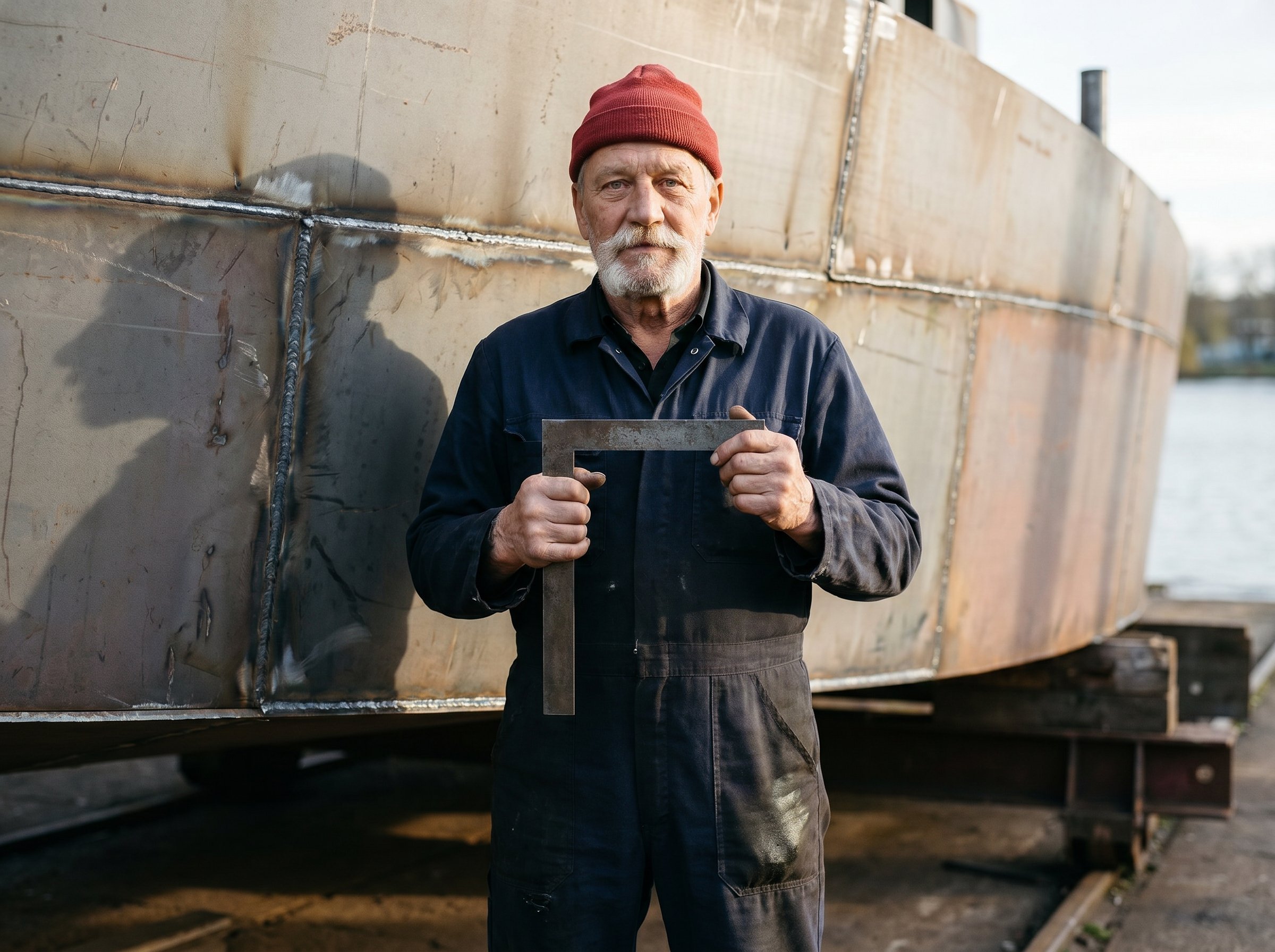
We worked the Slipway-1 area first. The half-built river-tender hull was at frame-Stage-3 — the side-plates welded, the deck-beams not yet down. He stood at the long side and held the heavy steel Anschlagwinkel at chest-height because it was the object that explained the work without him having to explain it. He suggested the angle. He suggested the height of the layout-square. He did not pose, he measured.
The Müggelspree-side light at 15:35 was raking from camera-right, warm-yellow, the kind of late-afternoon May light Berlin gives perhaps fifteen days a year. The hull behind him gave a deep open-shade fill on his left side. Portra reads this kind of light without any push.
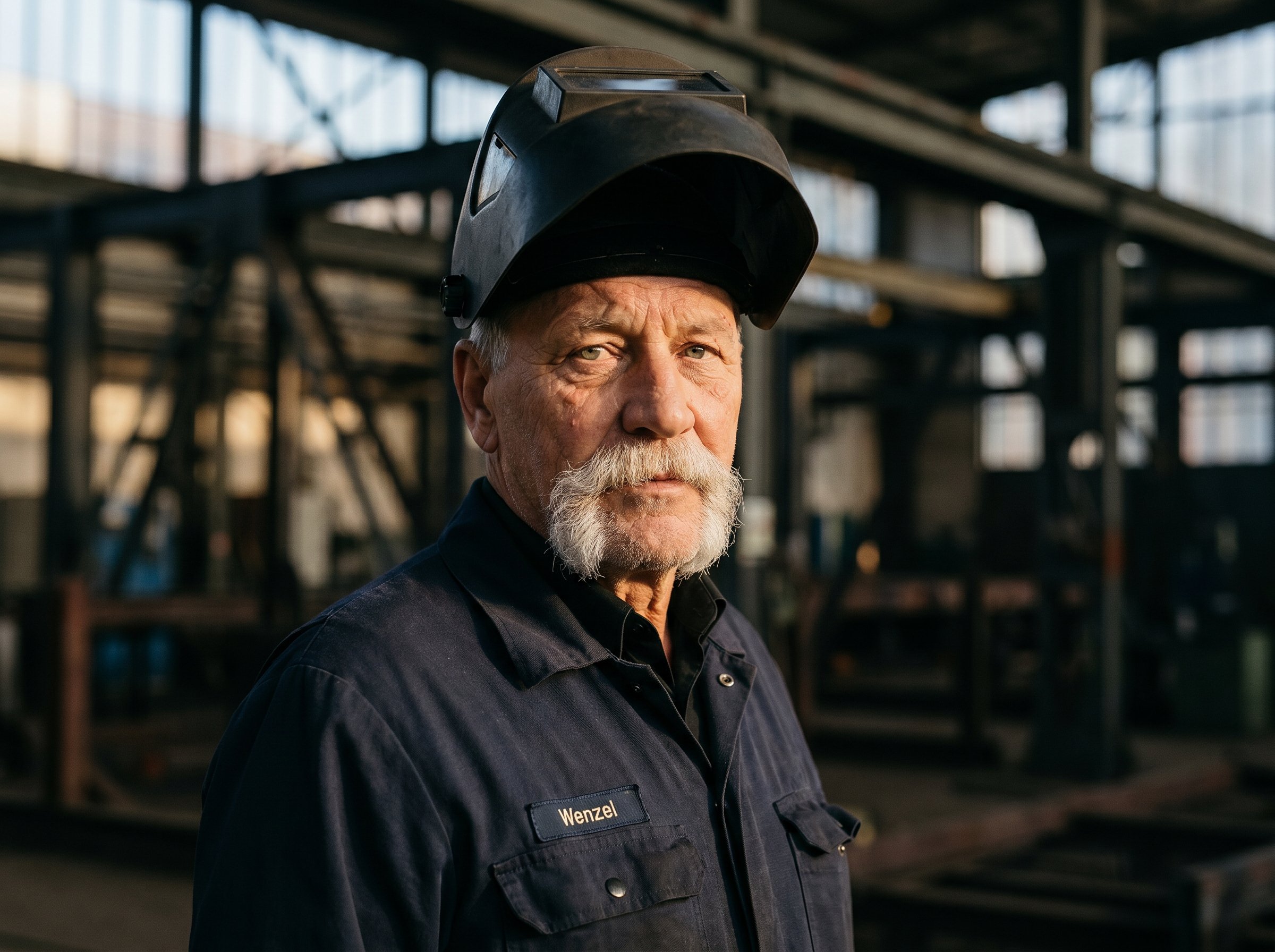
We moved to the half-shadow of the Slipway-Halle-eave for the tight portrait. Forty-five years on the Werft has built a face that does not need light staging — the bone-structure carries itself, the deep weathering plus the white wide-brush moustache plus the half-profile gives the camera everything it needs. He lifted the welding-shade onto the forehead. He looked at the camera. He did not smile and he did not perform not-smiling. He just looked.
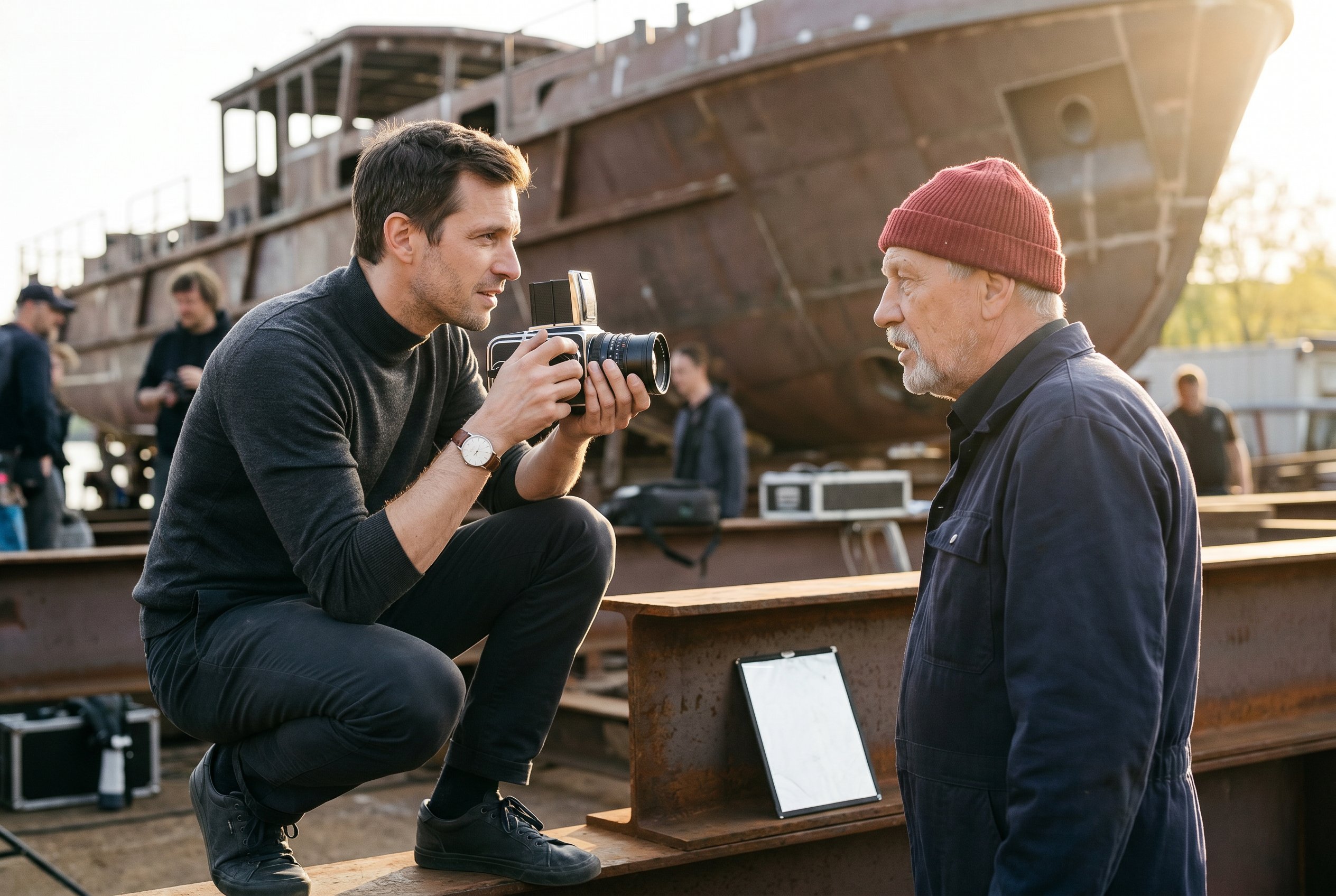
The making-of-frame is from the gap between the two finals — the Cast-Scout in all-black crouched at his chest-height, the Hasselblad lowered, conversation about which year the river-tender was scheduled to leave the Slipway (autumn 2027) and which Werft had welded its sister-ship in 2008 (Stralsund, gone since 2012). The work-conversation is the part that does not appear in the final frames but is the part that holds them.
He kept the steel Anschlagwinkel in his hand for the whole shoot. He said at the end: Das Werkzeug bleibt in der Hand. Sonst bin ich nicht ich.
The Werft-axis lead-card BER-019 plus this shoot reads as a paired documentation: the setcard carries the biographical line, the shoot carries the work-light at the slipway. The 6x6 medium-format look serves the Slipway-1 over-the-shoulder framing where 35mm-aspect-ratios would collapse the hull-mass into background.
Forty-five years on the Werft does not need a sentence under it. The hand on the layout-square at chest-height in late-May raking sun does the sentence by itself.