Salle Sept — Aïcha Ben-Salem-Rivoire at Perrotin Marais After Hours
A two-frame Purple-Magazine after-hours editorial built around a gallery-assistant who grew up backstage at the Avignon-Festival. The shoot was the close-of-evening at Perrotin Marais on Rue de Turenne, the night the Susumu Kamijo show was still up. Aïcha unlocked the gallery again at 22:30 after the public closing, killed the room-lights, left one overhead working-spot-light up, and the white-cube became a stage.
I had cast her the day before at the gallery — she gave me twenty minutes at the lunch-break and the substrate I needed in two sentences. Her mother is a stage-set-designer at the Avignon-Festival; she was raised in the wings of the Cour-d'Honneur from age four. The first thing she told me about her job at Perrotin was that the gallery floor is a stage and the assistant is the third-actor — the one who makes the room hold while the painting and the visitor have the scene. That was the brief. The shoot is two frames of that one sentence.
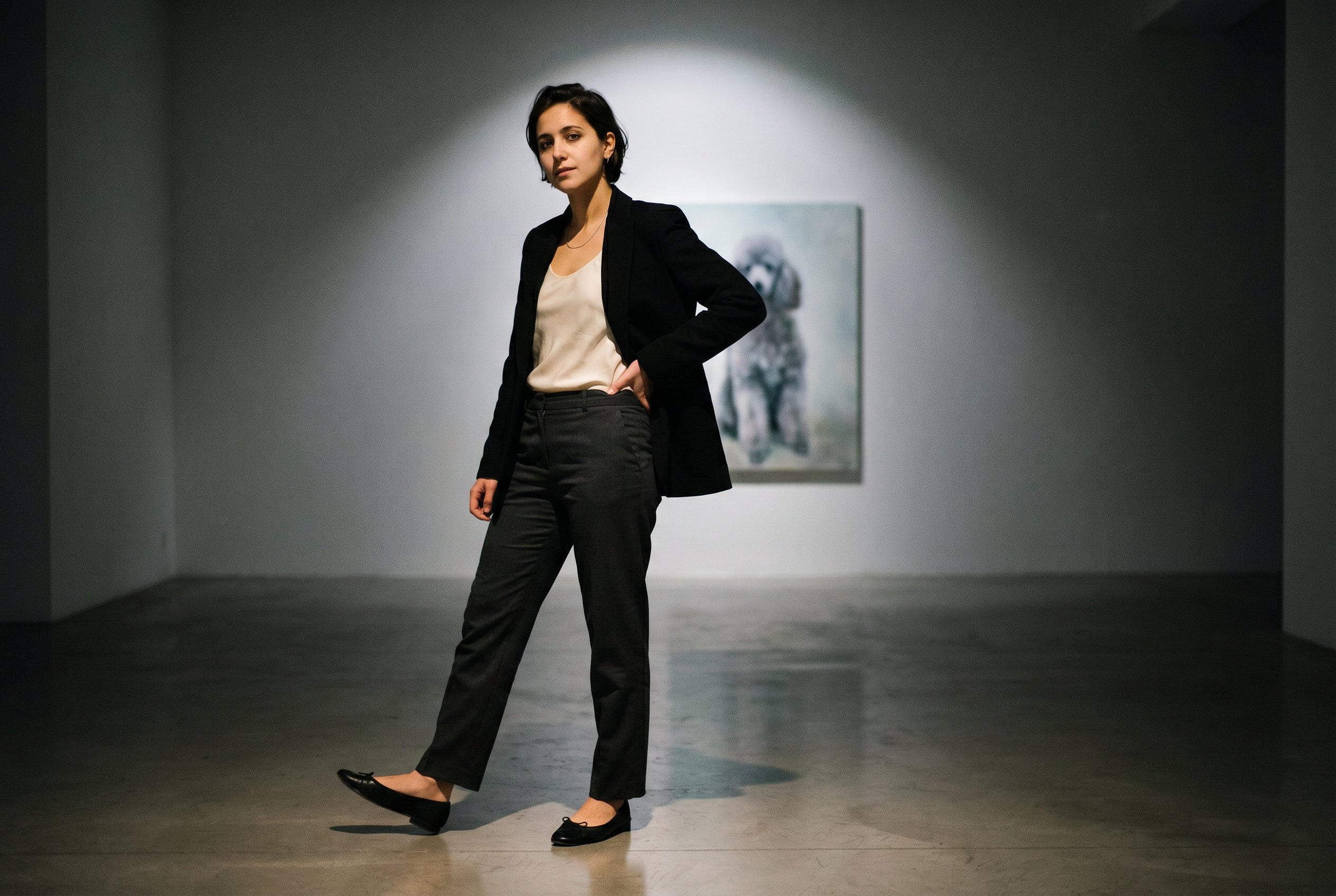
The first frame is the stage-cross — Aïcha mid-step at the centre of the white-cube room with her left foot just lifted off the polished-concrete floor and her right hand at her hip, the long-line tailored ink-black wool blazer over the cream silk tank-top and the charcoal worsted-wool trousers, low-heeled Repetto-flats, the single overhead spot-light throwing a soft directional beam onto her shoulder-and-jaw plane and leaving the rest of the room in low ambient half-light. A Susumu-Kamijo poodle-painting still hanging on the wall behind her in deep soft-focus. The single asymmetric silver hoop in her right earlobe is the only ornament she let me keep in frame.
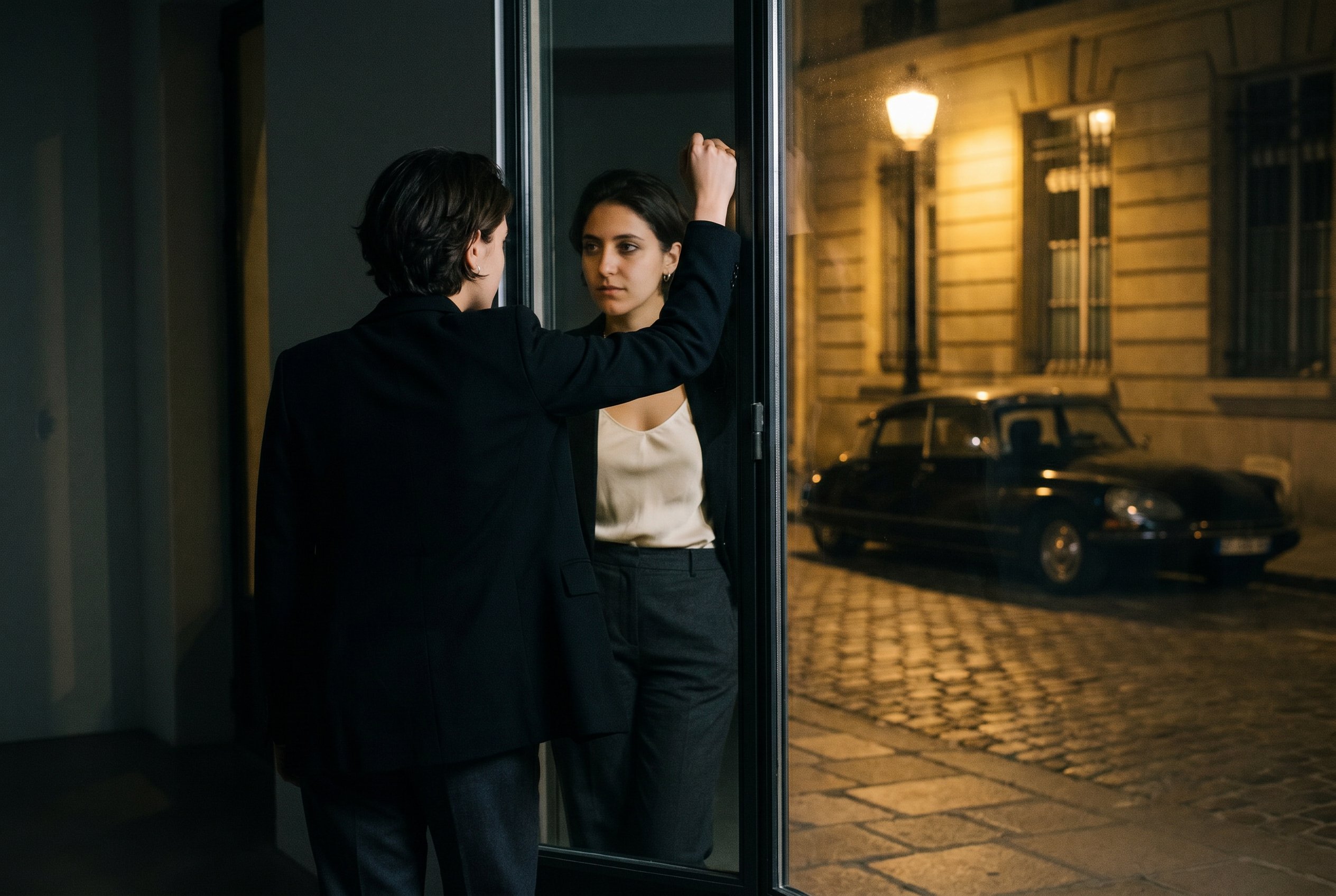
The second frame is the threshold — Aïcha at the floor-to-ceiling window-glass in three-quarter from behind, her left forearm resting at shoulder-height against the window-frame, looking out at the Rue de Turenne night-quartier. Her face and shoulders are half-reflected back as a soft mirror-image in the dark window-glass. Outside, the cobble-street holds a single Haussmann lamp-post throwing a warm sodium-glow and a parked black Citroën DS in deep soft-focus at the kerb. This is the after-hours register Purple does well — the working-figure at the closed door looking out, not posed, not announced, simply the person who is still in the room when the room is empty.
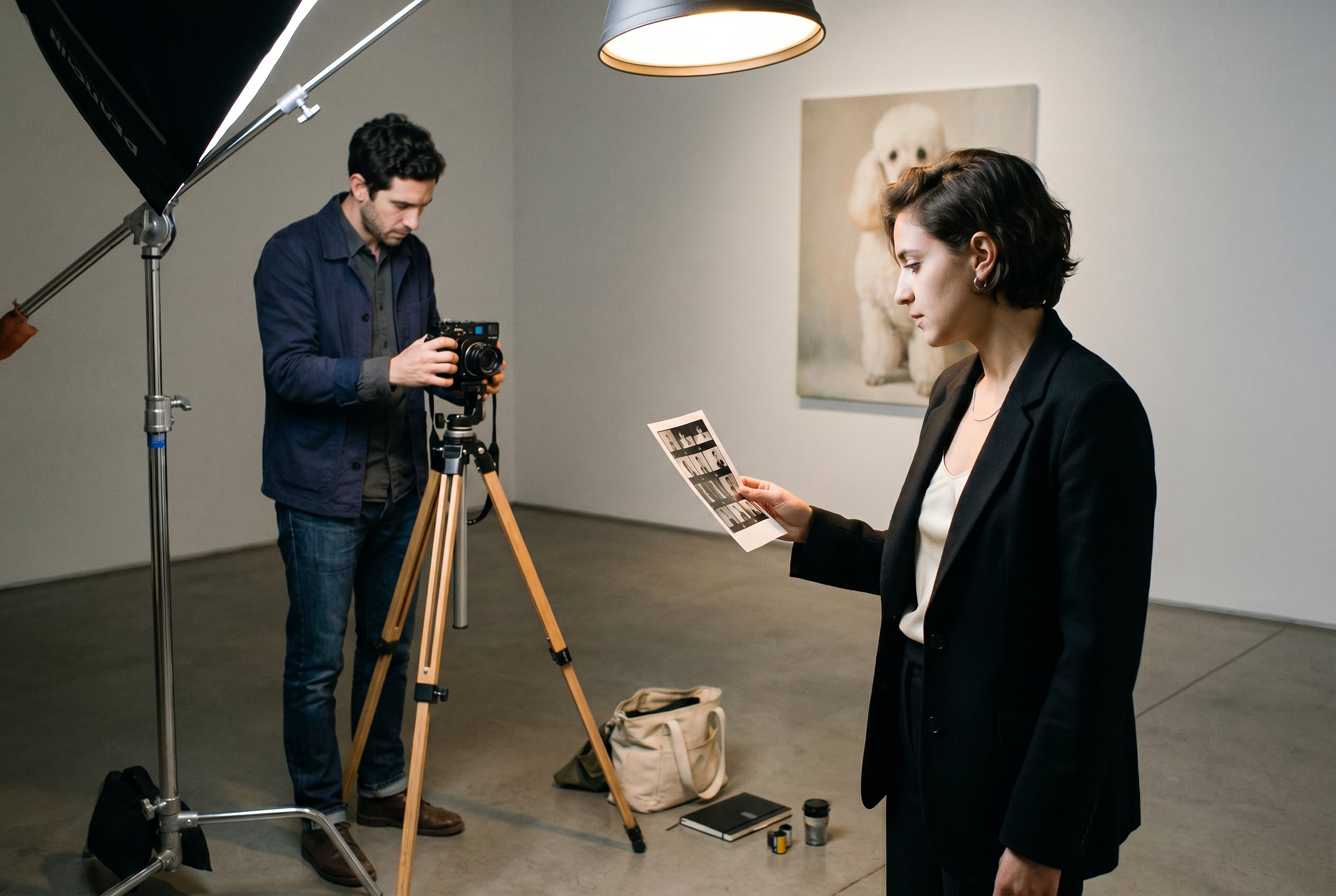
The making-of frame is the pause between the two finals at 23:08. Aïcha is at the wall with a small contact-print from the first frame held in her left hand — she had asked to see it before we set the window. I am to the left of frame adjusting the Mamiya 7-II on the wooden tripod, my back three-quarter to camera, the C-stand with the small soft-box at the lower-left foreground. Two used 120-film-canisters and a folded canvas-bag on the polished-concrete floor at my feet, my black Hobonichi-A6 next to them. The atmosphere was quiet — Aïcha had locked the front door at 22:25 after the last visitor, and the room held that specific Marais-after-hours stillness where the cobble-street outside makes more sound than the gallery inside.
Brief-class met: editorial-portrait, gallery-after-hours-intimate, in the Naive-French-Editorial register Purple Magazine still owns. Wolfgang-Tillmans plus Olivier-Zahm editorial restraint, a hint of Anders Petersen low-light tonality, the Avignon-backstage substrate as the unspoken thematic anchor. A Purple-Magazine SS27 Paris-issue Marais-portfolio would publish the two finals as a double-spread with the making-of as the inside-back-cover behind-the-scenes notebook frame. The shoot took forty-three minutes from the moment Aïcha killed the room-lights to the moment she unlocked the front door to let me back out onto the Rue de Turenne.