Hiroshi Sasaki-Yonezawa — Praça da Liberdade Sunday-Feira, Second Corner
Catalog Brief
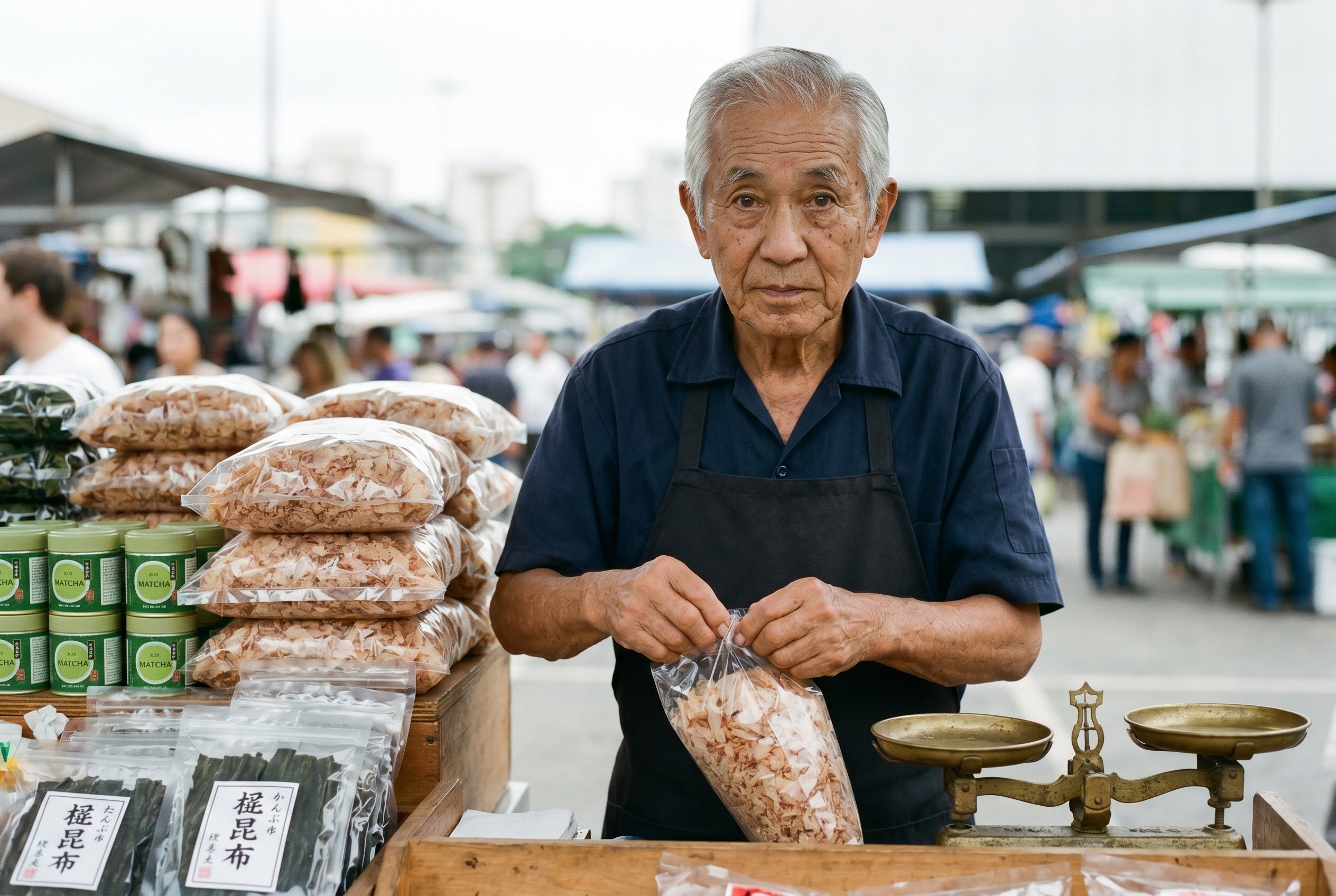
Liberdade Sunday-Feira, second-corner dry-goods stand, 11:05 BRT. Issei man, seventy-one, behind a low table of katsuobushi-bags and matcha-tins, labelled by hand in Japanese and Portuguese. He measures by feel, not by the scale at his elbow. Reference-Tiefe present. Field-Book SAO-2026-Q2-011. Suggestion: book for the three-generation-essay anchor (Document-Journal Brazil-issue cultural-pages) alongside the takoyaki-press grandmother — the Issei working-tradesman as the upstream sentence of the Feira-spine.
Story
I came back past the second corner on the third Praça-loop because the wholesaler had been working with both hands in motion the whole hour I had been on the south corner. The brass two-pan scale sat at his right elbow the whole time, untouched. He filled a quarter-kilo of katsuobushi by feel, sealed the bag, wrote the price on the bag in Japanese first and then Portuguese underneath, both in a small, even ballpoint hand. The customer was a Sansei woman in her forties — she watched his right thumb adjust the corner of the bag and nodded without comment. The transaction was three sentences. He looked up at me once between customers, registered the camera at my hip, did not change posture. That is the Issei working-rest-position. The wrist does the language the face does not need to. I asked in Portuguese whether he would sit for a setcard reference next Sunday at the same stand. He said yes in Japanese and repeated it in Portuguese for the record. We exchanged numbers via the daughter-cohort at the takoyaki-press across the corner, who knew him by name.
Biografie
Born Yokohama 1955. Father a small-warehouse manager in the Yokohama dry-goods trade, mother a Yokohama elementary-school teacher. Family emigrated 1972 in the second-wave Nikkei-paulistano post-Vargas cohort, settled Liberdade Rua Galvão Bueno, took over a small wholesale-position from a cousin who returned to Japan. Hiroshi worked the wholesale-warehouse from age seventeen, took over the Sunday-Feira stand-rotation from his uncle in 1984. Married 1980 to a Sansei woman from Mogi das Cruzes Nikkei-farming community, two daughters (both now in São Paulo working — one in Liberdade indie-publishing, one in Mogi-das-Cruzes agricultural-cooperative administration), one grandson aged seven. He has worked the same Sunday-Feira stand-position for forty-two years, the brass two-pan scale a wedding-gift from his father-in-law. He has never weighed a single sale on it. It sits at his elbow as the working-altar, not the working-tool. The hand is the scale.
Reference Depth Justification
The Issei first-generation senior-trade-body is the upstream-sentence of the Liberdade three-generation-essay. Without Hiroshi at the second-corner, the takoyaki-press grandmother (Akemi's family, SAO-007 lineage) and the Sansei father at the mochi-cart (Roberto's family-network, SAO-009 lineage) have no upstream working-position to read against. The brass two-pan scale that he has never used in forty-two years is the non-googlable character-anchor: a wedding-gift functioning as the working-altar of the trade, the visual sign that the hand-economy is older than the metric-economy. The Diesel-Editorial-Anti-Glamour discourse (foundation: content/diskurse/scandinavian-street-casting-und-diesel-editorial-praxis-konzept.md) extends naturally to the paulistana-Japanese first-generation senior-trade-body: this is a face that refuses idealisation by being entirely present to the working-trade. The hyper-authentic-casting-anti-glamour-editorial-20202026 lineage (foundation: same discourses-folder) calls for exactly this register — the body of the trader as the location, the brass scale as the working-altar, the hand as the language.
Catalog Category Routing
Primary: senior-working-body, Issei first-generation, paulistana-Japanese-diaspora, weights-and-feel-trade. Secondary: anti-glamour-editorial, three-generation-essay-anchor, Document-Journal-Brazil-issue cultural-pages. Cross-route candidates: REVERCE Sao-Paulo-Nikkei-diaspora-cluster, brand-context-fictive Issey-Miyake-Asia-South-America-issue, editorial-brief-fictive ApartamentoMagazine-Brazil-essay.
Suggested Next Step
Book Hiroshi for a one-hour Sunday-Feira-stand sit alongside the takoyaki-press grandmother across the corner — the two Issei-working-positions as the upstream-sentence pair of the three-generation-essay. Editorial deliverable: two single-frame portraits plus one making-of (the corner-walk between the two stands). Tentative date: next Sunday 2026-05-31 at the same hour, contingent on Stockholm-Paris-Sprint return-schedule.
Prompts
Bild 1 — closeup-portrait.jpg (model: nano-banana-pro JPG Q85 2K)
Contemporary documentary-fashion editorial closeup-portrait of a seventy-one-year-old Issei (first-generation Brazilian-Japanese) senior dry-goods wholesaler at his Sunday-Feira stand at the second corner of the Praça da Liberdade in São Paulo, three-quarter-body framing with the working-hands lifted to a quarter-kilo katsuobushi bag mid-fill, his right thumb adjusting the corner of the clear plastic bag in the practiced gesture of forty-two years of hand-measure-trade, the small brass two-pan scale at his right elbow untouched on the wooden table, behind him stacked clear-plastic bags of dried bonito flakes plus matcha-tins plus kombu hand-labelled in Japanese and Portuguese in small even ballpoint script, soft Sunday-late-morning São-Paulo overcast diffused light from camera-front-left, fine deep-wrinkle skin texture preserved honestly, short cropped grey-white hair with the side-part of a 1972-emigration-cohort senior man, fine dark-brown eyes looking directly into the lens with the attentive resting-attention of a working-tradesman who has just registered the camera but has not changed posture, wearing a plain dark navy short-sleeve workshirt plus a clean apron tied at the waist, no logos, no watches, no visible readable text in frame, the working-rest-position of the Issei senior-trade-body, photographer style of Sebastião Salgado plus Bob Wolfenson plus a hint of Hiromix-color-restraint, medium-format Phase One IQ4 rendered as Kodak Portra 400 fine-grain, 80mm Planar portrait-perspective, contemporary 2026 anti-glamour-documentary-fashion register for a Document Journal Brazil-issue cultural-pages working-tradesman-portrait commission, JPG Q85 output, no signage, no readable text.