SAO-2026-Q2-007 — Akemi Yamashiro-Tanaka
Catalog Brief
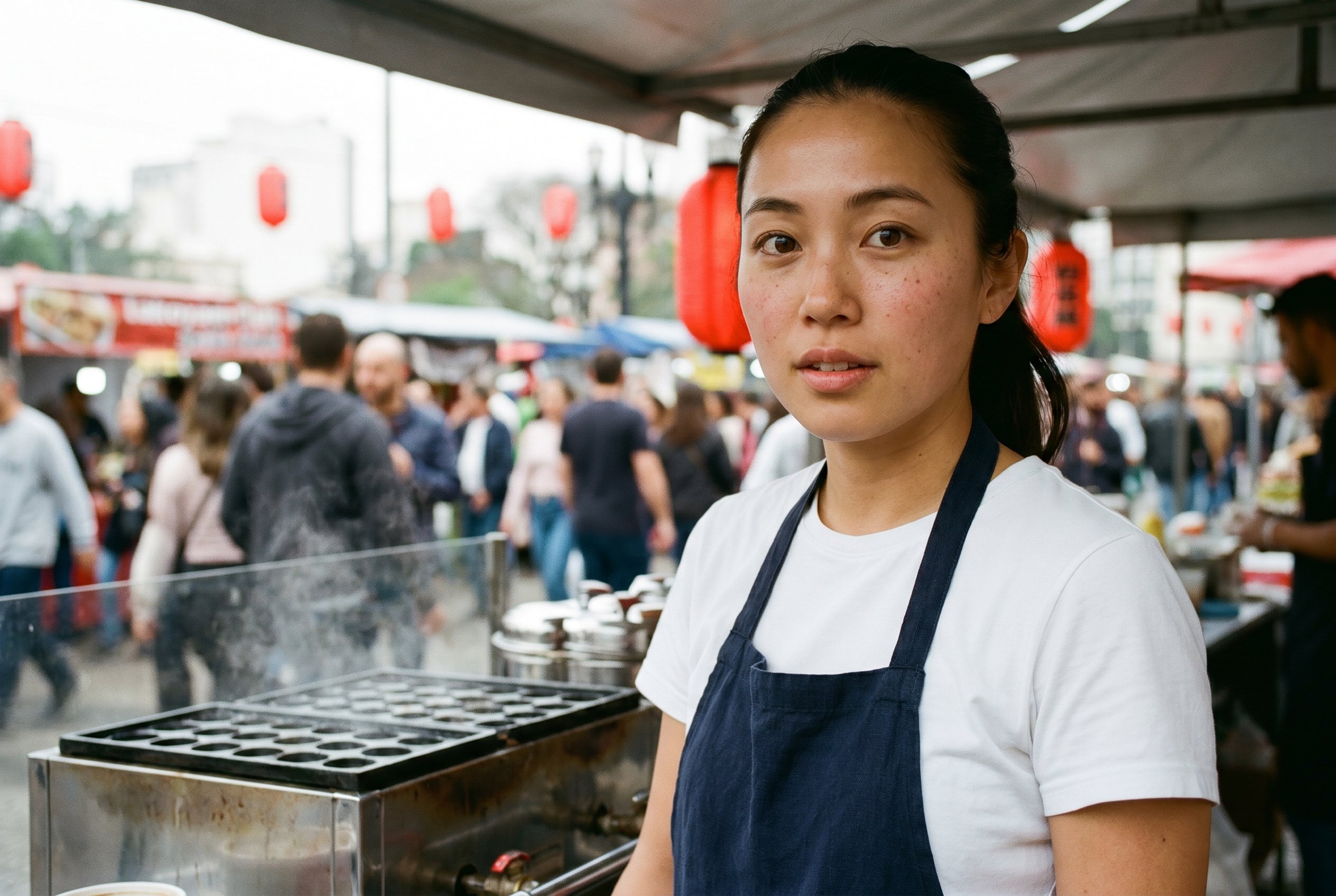
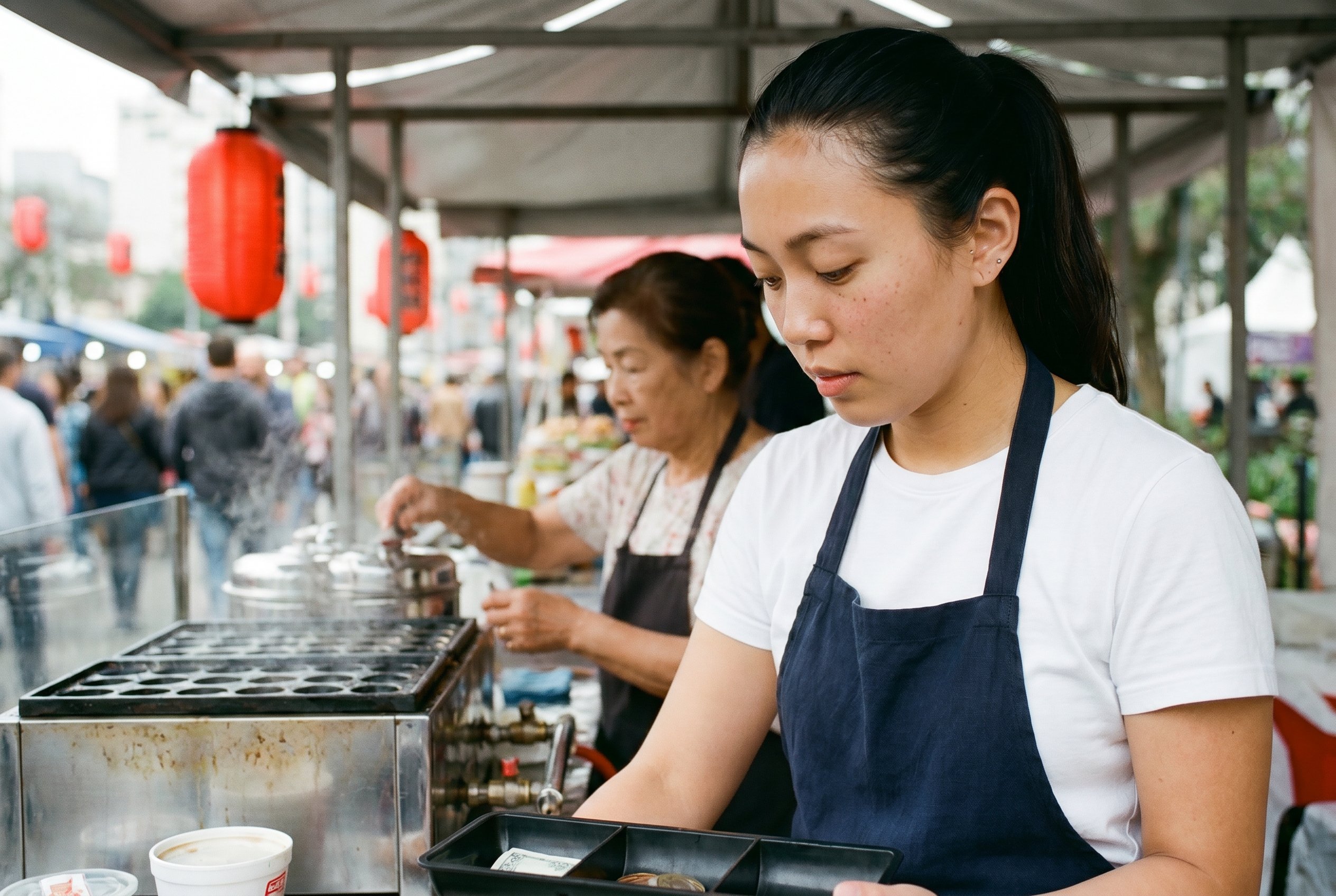
Catalog reader, Liberdade Sunday Feira three-generation stall, the Yonsei-Tochter holding the till position. Twenty-four, paulistana Nikkei-fourth-generation, taking orders in Portuguese and switching to Japanese for her Issei grandmother behind the takoyaki press without lifting her eyes — the code-switch is the body-spur, not a performance. Catalog has the Nikkei-Diaspora axis as a stated gap before this Sunday, the methodology hypothesis (diaspora generation-position coverage as load-bearing) gets its first Yonsei pin here. Field-Book entry SAO-2026-Q2-007 promoted from placeholder after the second pass at 11:55 BRT, name and contact-card exchanged. Proposal: weekday visit at the indie-publisher Studio-Mishi office on Rua dos Estudantes where she works production-assistant Mon-Fri.
Story
The Praça was already full at 10:25 BRT, Sunday Feira at full register. I had clocked the three-generation takoyaki stall on the first lap — Issei grandmother at the press, Nisei or Sansei mother at the prep-table, mid-twenties daughter at the till. Came back at 10:40 BRT to order two takoyaki and watch the till-position from one meter away. The order was in Portuguese, paulistana standard, neutral register. The grandmother called something from behind the press in Japanese — a question, a clarification on the sauce. The daughter answered in Japanese without lifting her eyes from the order-tray, then back to Portuguese for the next customer in line, then back to Japanese for the grandmother. The whole hand-off was sub-second, no hesitation at the language-switch, the body did it. That is the diaspora-working-body in its Yonsei register — the language-pivot lives in the wrist and the gaze-economy, not in a code-switch I-am-thinking-about-it pause. Came back on the second pass at 11:55 BRT after walking the Praça-perimeter. She had a five-minute lull. Name Akemi Yamashiro-Tanaka. Twenty-four. Weekday-job at Studio-Mishi indie-publisher, three blocks toward Rua dos Estudantes, production-assistant since 2024. Sundays at the family stall since age nine. I gave her my card, said São-Paulo casting catalog, would she sit for fifteen minutes midweek at the Studio-Mishi office. She read the card, looked at the lull-clock, said come Tuesday around 16:00, the office is quiet then.
Biografie
Akemi Yamashiro-Tanaka, born 2001 São Paulo Liberdade-Sé. Grandfather Hiroshi Yamashiro (Issei, born Naha-Okinawa 1939, arrived São Paulo via Santos 1958 as part of the post-war Okinawan-emigration wave, opened the takoyaki-cart in 1972 on the same Praça-da-Liberdade Sunday-Feira corner where it still stands). Grandmother Sumie Yamashiro (Issei, born Okinawa 1942, arrived 1961 via family-reunification visa, runs the press since Hiroshi's stroke 2019). Mother Eliana Yamashiro-Tanaka (Nisei, born São Paulo 1968, paulistana-Portuguese father, weekday-job teacher of Japanese at Aliança Cultural Brasil-Japão in Liberdade). Father Marcos Tanaka (Sansei, born São Paulo 1965, IT-systems-administrator at Banco Sumitomo-Mitsui Brasil). Akemi is the youngest of two — older brother Yuto, 28, Sansei-coded paulistana, lives in Santa Cecília plus works at a mid-size advertising-firm. Akemi finished public Escola Estadual Tomás Galhardo 2019, studied editorial-design at SENAC 2020-2022 (with the pandemic-shutdown breaking the middle-year into remote-learning), graduated 2022. Took a year at a magazine-distribution-startup in Bela Vista (2023), then moved to Studio-Mishi in early 2024 — the Liberdade-based indie-publisher specializing in Japanese-Brazilian-diaspora literary anthologies and visual-essay books. Single, lives at home with parents on Rua Galvão Bueno (two blocks from the Praça). Speaks Portuguese (paulistana standard), Japanese (Okinawa-dialect-influenced household-register from the grandparents plus standard learned at Aliança Cultural), basic English.
Reference Depth Justification
The diaspora-Nikkei-Yonsei working-body class — entirely new for the catalog, the methodology hypothesis predicted three-generation coverage as the load-bearing axis for the Liberdade-Sunday-Feira pull — carries here at four readable points:
(1) Code-switch body-economy: the Portuguese-to-Japanese-and-back pivot lives below the conscious threshold. The eyes do not lift to the grandmother, the body does not turn, the language switches at the wrist and the gaze stays on the order-tray. This is the fourth-generation diaspora-language-position, distinct from third-generation (slight visual confirmation), distinct from second-generation (more deliberate). SAO-007 is the first Yonsei pin.
(2) Three-generation stall-economy: the takoyaki-press is a literal generation-machine — Issei at the press, Nisei at prep, Yonsei at the till. Each generation occupies its body-economically appropriate station, the diaspora-position is spatialized. The catalog has nothing comparable from any city.
(3) Weekday/Sunday-mode-split: she runs the till at the Sunday Feira but works production-assistant at an indie-publisher Mon-Fri. The mode-split (family-economy on Sundays, indie-publishing on weekdays) is the contemporary Yonsei paulistana-Liberdade economic-pattern — the family-stall continues across generations as cultural-ballast, not as primary income.
(4) Wardrobe-substrate: dark-navy linen apron over a plain white tee, hair tied back with a thin black band, small silver post-earrings, no other adornment. The Yonsei mid-twenties Liberdade-Sunday register, plain plus quiet plus functionally close to her grandmother's apron-cut.
Catalog-density-note: SAO-007 plus SAO-008 (Yonsei-mode-insider-edge) plus SAO-009 (Sansei-mid-career) plus SAO-010 (diaspora-LGBTQ-crossover-speculative) gives the catalog Nikkei-diaspora generation-position-coverage Issei-Nisei-Sansei-Yonsei in 24 hours of Liberdade fieldwork. Tag-2 methodology hypothesis structurally validated.
Catalog Category Routing
Primary: Nikkei-Yonsei mid-twenties paulistana, three-generation-diaspora working-body, code-switch service-trade, Liberdade-Sunday-Feira substrate. Secondary: indie-publishing production-assistant mid-twenties paulistana, contemporary diaspora-Brazilian editorial-portrait, fourth-generation-immigration documentary-essay. Editorial fit: Aperture diaspora-essay section, NYT-Magazine Brazilian-Japanese-immigration documentary register, piauí Liberdade-quarter cultural-essay, Vogue-Brasil contemporary-diaspora portrait, Folha S Plus Liberdade-economy supplement, Studio-Mishi own-publication editorial cover if a story develops with the indie-publisher angle.
Suggested Next Step
Phase 1: Tuesday 2026-05-26 at 16:00 BRT, fifteen-minute sit-down at Studio-Mishi office on Rua dos Estudantes (no camera, conversation only — Akemi-confirmed slot). Phase 2 (consent-pending): test-sheet at the Sunday Feira next weekend 2026-05-31 in the three-generation-stall frame — three setups, the till-position, the language-handoff to grandmother, the doorway-frame at the Studio-Mishi office. Mauricio-Nahas paulistana-documentary register crossed with the contemporary Brazilian-Japanese-diaspora visual-essay tradition. Phase 3: three-generation-portrait extension — if Akemi consents and the grandmother consents (Akemi as intermediary), a single frame of Issei-Nisei-Yonsei at the press, the catalog-cornerstone Nikkei-diaspora-axis triptych.
Prompts
Bild 1 — closeup-portrait.jpg (model: nano-banana-pro 2K)
Contemporary documentary-fashion editorial closeup portrait for a São Paulo casting catalog, head-and-shoulders framing, twenty-four-year-old paulistana Nikkei-Yonsei fourth-generation woman of Okinawan-Issei-grandparent plus Brazilian-Portuguese-maternal heritage, Sunday-Feira till-position at her grandmother's takoyaki-press stall at Praça da Liberdade, oval face with the Okinawan softer-jaw plus the slight-aquiline maternal-Portuguese nose-bridge crossed into a Yonsei-mixed register, fine-natural slightly-arched dark brow not heavily groomed, soft natural lower-lip without makeup, almond-shape brown eyes with the inner-corner soft-fold characteristic of Yonsei-mixed substrate, dark-brown straight medium-length hair pulled back tight in a low ponytail with a thin black elastic band and clean temples, warm-medium ivory-with-olive-undertone Yonsei-paulistana skin with honest pore-texture and fine winter-sun cheekbone-warmth preserved, dark-brown eyes looking directly into the camera lens with the alert till-attention of a Sunday-Feira market-worker who just took an order and has a thirty-second pause, the body-economy of a third-and-fourth-generation diaspora-till-position carried in the soft shoulder and the slight forward-lean, wearing a dark-navy linen short half-apron over a plain white short-sleeve cotton t-shirt with no readable text, small silver post-earrings, no other jewelry, no makeup, warm Sunday-late-morning São-Paulo overcast diffused light from camera-front-left across the cheekbone, the chrome edge of the takoyaki-press plus the soft fall-off of Praça-da-Liberdade Sunday-Feira crowd behind, photographer style of Mauricio Nahas plus Bob Wolfenson paulistana-documentary tradition crossed with Aperture diaspora-essay register, medium-format Phase One IQ4 rendered as Kodak Portra 400 fine-grain, 80mm Planar natural-perspective, contemporary 2026 documentary-fashion São-Paulo Liberdade-diaspora-portrait register, honest texture preserved, no logos, no readable signage, no visible readable text anywhere in frame