SAO-2026-Q2-006 — Seu Damião Bezerra de Lima

Catalog Brief
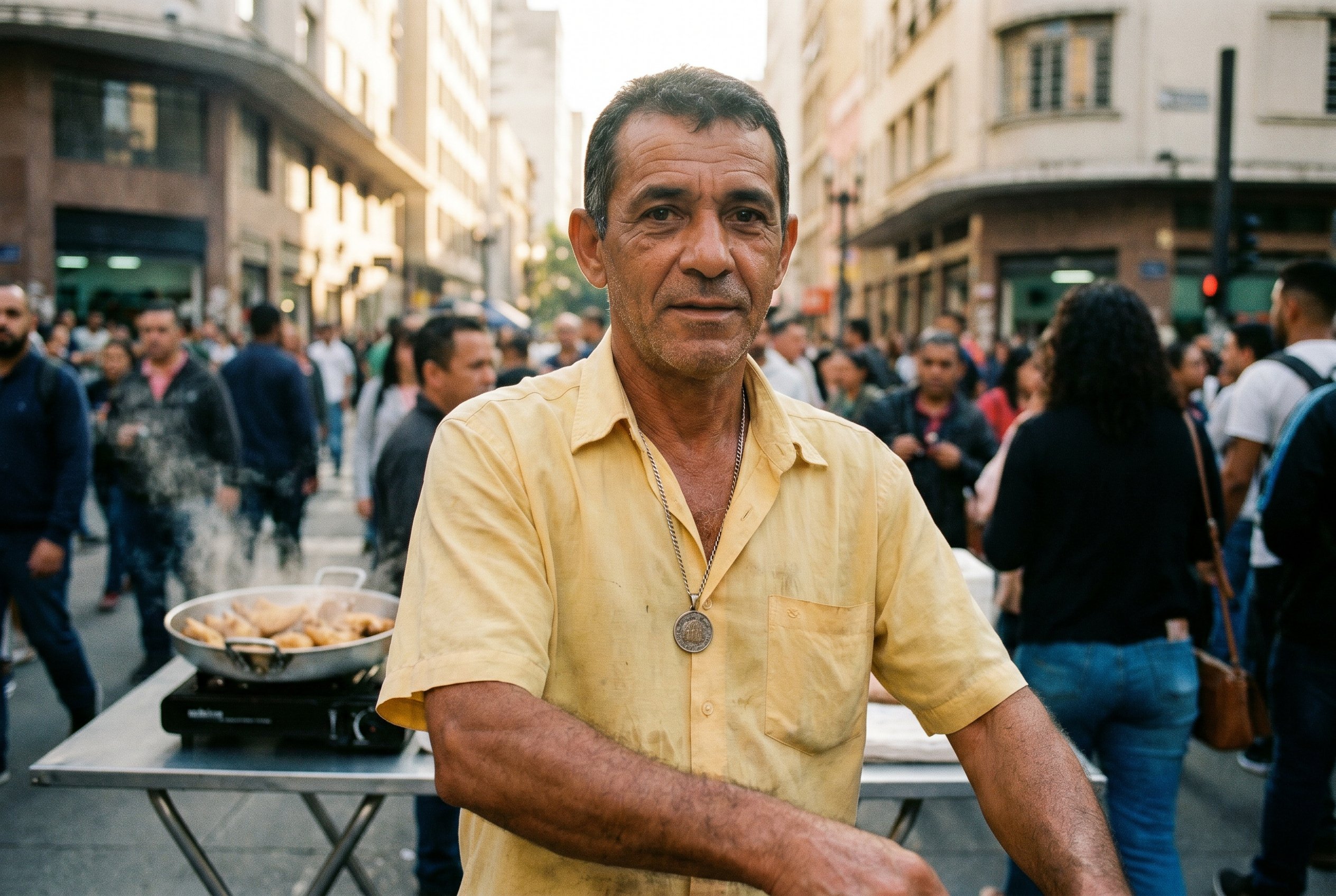
Catalog reader, second pin on the Nordestino-Migrant first-generation class in Vila-Madalena today. The Sunday street-vendor at the Aspicuelta-Wisard corner, late-forties, Pernambuco-Recife-born, runs a cassava-fritter folding-table since 2014. Reference-depth sits in the hands-fast-eyes-forward-scanning rhythm — the hands fold the fritter while the eye reads the next customer crossing from twenty meters away. The Northeastern-vowel-layer carries across the corner before the face does. Field-Book entry SAO-2026-Q2-006 promoted from placeholder to submitted after counter-conversation 15:10 BRT. Pair-pin with SAO-002 (Wagner, taxi-driver senior-migrant) at younger street-trade edge — same diaspora-substrate, different generation-and-trade-position. Proposal: Sunday-pre-rush visit next weekend 09:00 BRT for the second sit-down at the early setup.
Story
Saw the folding-table going up at 11:55 BRT during the 12:00 Aspicuelta walk. Logged him as SAO-006 placeholder, the body of a man who has done this exact setup-rotation every Sunday for twelve years. The Recife-vowel carried across the corner — he was calling something to a passing customer in the Pernambuco-Sertanejo cadence and the customer answered back in the same accent, a small Northeastern-pocket on a Vila-Madalena Sunday corner. Came back at 15:10 BRT during the afternoon-loop, the table was in full operation — three Sunday customers around it, the cassava-fritter pan on the small gas-burner, the row of fritters draining on a wire-rack. I waited for the rush to pause, asked for one fritter plus a question. He looked up, said claro, fala. Name Seu Damião Bezerra de Lima. Born Recife-Pernambuco 1977. Came to São Paulo with his older brother in 1998 looking for construction-work. Worked sixteen years on São-Paulo construction-sites — Itaquera, Aricanduva, Vila-Olímpia high-rise period. Knee-injury 2013 ended the construction-track. Started the Sunday-corner cassava-fritter table in 2014 with his wife Dona Edna (also Pernambucana, came to São Paulo 2001). Six days a week works a small kiosk at the Mercado de Pinheiros (sells the dry-mix plus the pão-de-queijo), Sundays runs this corner. Has a son in São-Paulo industrial-design studies at SENAC, second-generation paulistano. The Northeastern-pocket of Aspicuelta-Wisard is real and economically functional — six Pernambucan-Recife families work this six-block square as Sunday-vendors and weekday-kiosk-operators. Gave me a fritter, took my card.
Biografie
Seu Damião Bezerra de Lima, born 1977 in Recife-Pernambuco (Casa-Amarela neighborhood, Zona-Norte da Recife), came to São Paulo at 21 in 1998 with his older brother José following construction-work demand of the late-1990s São-Paulo high-rise boom. Father Severino Bezerra de Lima was a Sertanejo agricultural-worker from Caruaru who moved the family to Recife in 1989 looking for steadier work, mother Dona Lourdes from Pernambuco-Surubim (passed 2019). Damião is the second of four children — older brother José stayed in São Paulo (construction-foreman in Guarulhos), younger sister Edileuza in Recife (works at a Casa-Amarela bakery), youngest brother Marcelo went back to Caruaru to run the family small-farm. Damião studied through eighth-grade Escola Estadual José-Mariano-Filho in Casa-Amarela, did not finish ninth, started carpenter-apprentice work 1992. São-Paulo 1998-2013 worked sixteen years on construction-sites (Itaquera-zona-leste subway-extension period, Aricanduva mall-construction, Vila-Olímpia 2009-2012 high-rise tower-block). Knee-injury 2013 (left-knee meniscus, fell from second-floor scaffolding, three months recovery, never returned to full-load construction). 2014 started the Sunday-cassava-fritter folding-table with his wife Dona Edna Maria de Souza, also Pernambucana from Recife-Boa-Viagem (came to SP 2001, met Damião at a Bom-Retiro Pernambuco-restaurant 2003, married 2005). Lives in Itaim-Paulista zona-leste, owns the kitchen-base apartment. One son, Davi Bezerra de Lima, 19, second-year industrial-design at SENAC-Lapa, lives with his parents, will be the first university-graduate in the family. Speaks Portuguese (Pernambuco-Recife regional, the Caruaru-Sertão-vowel under a Casa-Amarela-Recife grammar), zero English.
Reference Depth Justification
The Nordestino-Migrant first-generation working-body class — pinned first by SAO-002 (Wagner, senior-male-driver edge) — gets its second pin at SAO-006 with a different trade-and-generation-position, and the catalog-density on this class is now load-bearing. Three readable points:
(1) Hands-fast-eyes-forward-scanning rhythm: the body-economy of a street-vendor with twelve years at the corner shows in the hands folding the fritter while the eye reads the next customer twenty meters away, a peripheral-vision-economy that construction-workers and street-vendors share but office-workers do not. Non-fakeable in a single frame, this is the body-substrate of a person who has lived a body-trade since age 15.
(2) Recife-Sertanejo-vowel layer: the Northeastern-vowel carries before the face — the open-A and the dropped-final-S of the Pernambuco-Sertão regional cadence, layered over a São-Paulo grammar acquired across 28 years of residency. The accent-body-match is the catalog-class-signature.
(3) Hands-and-forearm-substrate: sixteen years of construction-work plus twelve years of fritter-folding has set a specific forearm-economy — wide-set knuckles, thumb-and-index callus-pattern, the wrist-bone slightly enlarged on the dominant right side. The honest hand-architecture of a man who has used his hands as primary income for thirty-four years. Class 2 of the Day-1 hypothesis (Nordestino-Migrant first-generation) gets its second pin and the class is now formally validated as load-bearing across two generation-positions plus two trade-positions.
Catalog Category Routing
Primary: Nordestino-Migrant first-generation street-trade working-body, mid-career-hands-economy, Vila-Madalena Sunday-corner-economy. Secondary: Pernambuco-Recife diaspora portrait, São-Paulo street-vendor essay, construction-veteran second-career narrative. Editorial fit: Document-Journal first-generation-migrant portrait section, NYT-Magazine São-Paulo Northeastern-diaspora essay, Piauí magazine longform-photo-essay (Brazilian-migration register), Folha S Plus Vila-Madalena corner-economy supplement, Marie-Claire-Brazil working-portrait. Possible test-sheet candidate at the Mercado-de-Pinheiros weekday-kiosk for the broader trade-portrait.
Suggested Next Step
Phase 1: next Sunday 2026-05-31 09:00 BRT visit at the Aspicuelta corner during the pre-rush setup, no camera, conversation only, share a coffee from the corner cart. Phase 2 (consent-pending): test-sheet at the folding-table mid-rush, three frames — at the pan with the fritter mid-fold, the hands on the cassava-mix, the doorway-frame with the Aspicuelta-block behind. Document-Journal register, Mauricio-Nahas/Sebastião-Salgado Brazilian-documentary-tradition register. Phase 3: weekday Mercado-de-Pinheiros kiosk visit for the broader Pernambuco-trade-network frame, possible pair-portrait with Dona Edna for the diaspora-couple narrative.
Prompts
Bild 1 — closeup-portrait.jpg (model: nano-banana-pro 2K)
Contemporary documentary-fashion editorial closeup portrait for a São Paulo casting catalog, head-and-shoulders framing, forty-eight-year-old nordestino-Pernambuco-Recife first-generation migrant man of parda-Sertanejo heritage, Sunday street-vendor running his cassava-fritter folding-table at the Vila-Madalena Aspicuelta corner, oval-to-square face with the Casa-Amarela Recife-grandmother strong-jaw architecture and the Caruaru-Sertão high-cheekbone and a broad-bridged slightly-flat nose, defined natural dark brow, full natural upper-lip with a small smile-line cut at the left corner, dark-brown short-cropped hair with the temples gone silver-gray at the early-onset that runs in Pernambuco-male families, warm-medium golden-brown parda skin with the honest weathering of sixteen years on São-Paulo construction-sites plus twelve years at the Sunday-corner sun preserved, deep crow's-feet at the outer eye from the Sertão-vowel-laugh and the fritter-pan steam, dark-brown almost-black eyes looking directly into the camera lens with the alert peripheral-vision-economy of a corner-vendor reading the customer twenty meters away, the body-economy of a former-construction-worker turned street-vendor carried in the wide-set shoulders and the thick forearm carried slightly forward, wearing a plain weathered cotton butter-yellow short-sleeve work-shirt with the top button open and a thin silver chain at the collarbone holding a small saint-medallion (Padre Cícero, common Pernambucan-Sertanejo devotion), no other jewelry, no makeup, a small fresh oil-burn scar at the back of the right hand, the late-afternoon São-Paulo Sunday sun from camera-front-left across the cheekbone and the silver temple, the folding-table corner plus the cassava-fritter pan steam plus the soft fall-off of the Aspicuelta-Sunday-corner-crowd behind, photographer style of Mauricio Nahas plus Sebastião Salgado Brazilian-documentary tradition crossed with Tyler Hicks contemporary-documentary-portrait register, medium-format Phase One IQ4 rendered as Kodak Portra 400 fine-grain, 80mm Planar natural-perspective, contemporary 2026 documentary-fashion São-Paulo working-body-portrait register, honest texture preserved, no logos, no readable signage, no visible readable text anywhere in frame