Margaux Lévi-Strauss-Coulomb — Atelier, Rue de Charonne
Catalog Brief
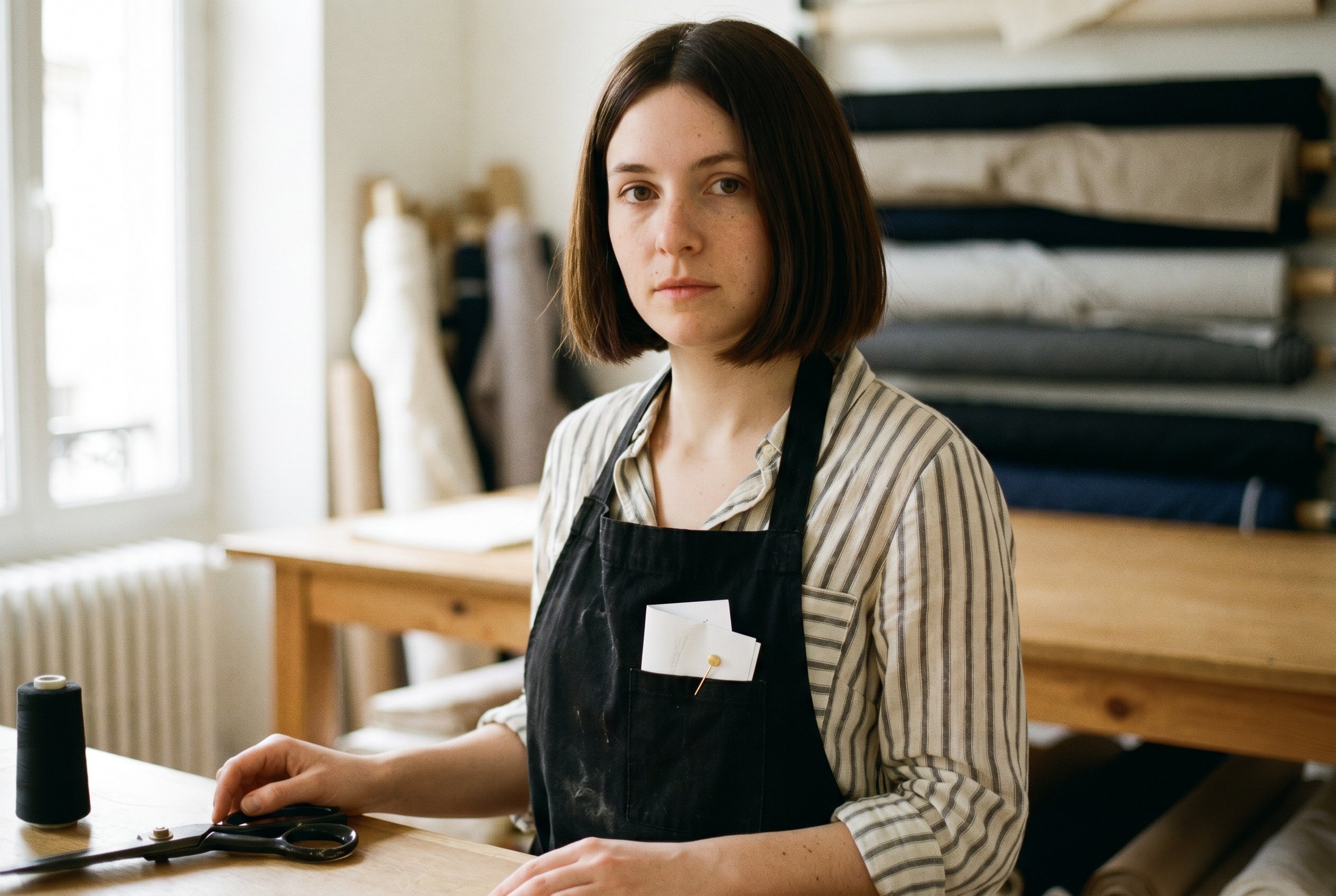
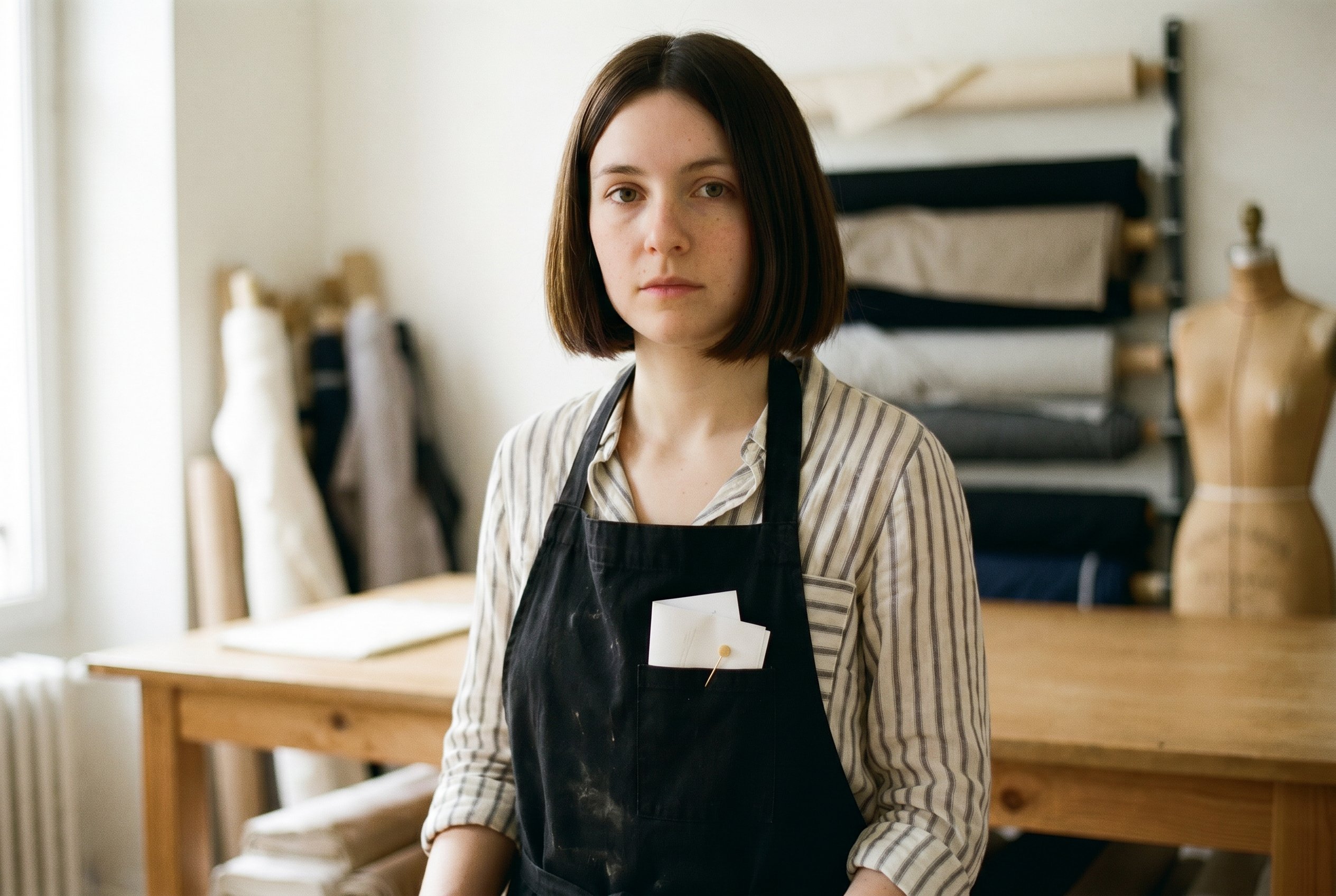
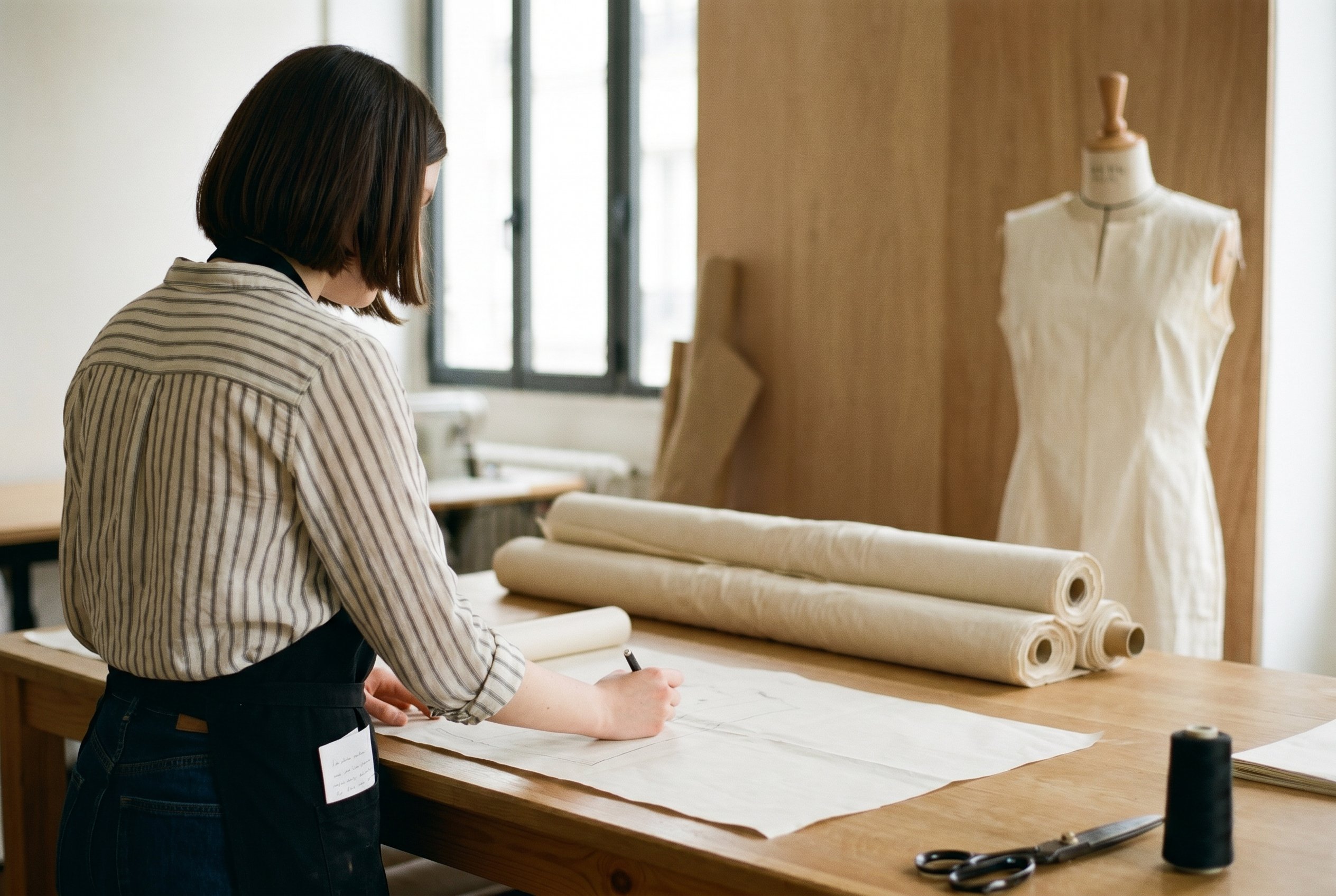
Second-floor atelier on Rue de Charonne, 18:32 CEST. Twenty-eight-year-old white-French indie fashion-designer at her cutting-table working through the second-collection patterns. Long-line ink-black raw-cotton workshop-apron over a faded oversized cream-and-grey pin-stripe man's-shirt with the sleeves rolled to the elbow, slim dark indigo denim, no jewellery except a single fine brass pin holding a folded thirty-page handwritten letter to her atelier-leader in Dhaka tucked into the apron-front-pocket. Worn-in nude lip-balm, dark-chestnut blunt-cut jaw-line hair with no parting, grey-green eyes, no makeup. The atelier was three rolls of unbleached Dhaka-cotton stacked at the back of the cutting-table, a wooden dress-form with an unfinished long-line raw-cotton dress in the corner, a small lacquered bobbin of natural-cotton thread plus a pair of Wiss-9 black-handled tailor's-shears resting on the table. She founded the label at twenty-one, runs it solo with three atelier-assistants, and has been sourcing cotton from a single Dhaka atelier for eight years on the same eight-year handwritten-letter-correspondence with the atelier-leader. The folded letter in the pocket was the May-letter mid-draft. Reference-Tiefe present. Field-Book PAR-2026-Q2-005. Suggestion: book Margaux as the Bastille-Indie-Designer face for the REVERCE Bastille-Indie-Designer-cluster, the slow-fashion-anchor for the Document-Journal slow-fashion-essay brief.
Story
I had walked from the Marais across the Place de la Bastille and pulled into the Rue de Charonne at six-twenty in the early-evening blue-hour light, climbing the four flights up to her second-floor atelier above a closed bookbinder's shop. She had said on the door-buzzer to come up and that she had thirty minutes before she had to finish the pattern-marking. The atelier door was open at the top of the stairs and the first thing I saw was the brass pin holding the folded letter at her apron-pocket — a small visual-anchor that I read before she had even turned around. She was standing at the cutting-table with a pattern-paper-marker in her right hand, working a marker-line across the raw-cotton pattern-sheet for the new long-line dress. The dress-form to the right had the prototype draped on it, unfinished, a single basting-line down the right-side seam. The order-of-information she gave me was: born Paris-12e 1998, École Duperré 2016–2019, founded the label at twenty-one with a small inheritance from her paternal grandmother (the Alsatian-Jewish Lévi-Strauss-cousins side), and the entire eight-year story of the Dhaka atelier-relationship that is the spine of her practice. Her atelier-leader is a fifty-six-year-old Bangladeshi woman named Salma whom Margaux has visited three times (December-2018, March-2021, November-2024) and with whom she has corresponded by handwritten letter every two months since the first visit. The folded thirty-page letter in the apron-pocket was the May-letter mid-draft — Margaux writes the letters by fountain-pen on cream Pierre-Bergé paper and posts them at the Bastille post-office every fifth or seventh of the month. The reply usually arrives ten-to-fourteen days later. She has every Salma-letter in a wooden box on the second shelf of the atelier-bookshelf — eight years of fortnightly correspondence, the entirety of the working-relationship preserved as paper. The Wiss-9 tailor's-shears on the table were her grandmother's from the 1958-Alsace-family-house. The brass pin at the apron-pocket was her own design from the second-collection of the label.
Biografie
Born Paris-12e 1998 to David Lévi-Strauss (born 1965, ENS-Paris philosophy-graduate, currently CNRS-researcher in 20th-century political-philosophy, paternal-line Lévi-Strauss-cousins from Alsace 1880s-Strasbourg-arrival, the family-house in Sélestat sold in 1939 before the Drancy-deportation and never recovered, the paternal-grandparents survived in hiding in the Hautes-Pyrénées 1940–1944) and Anne Coulomb (born 1968, currently architectural-historian at the Cité-de-l'Architecture, maternal-line Coulomb Bordelaise non-religious bourgeoise wine-trading-family). Grew up Paris-12e and from age twelve in the Bastille-12e Rue de Reuilly family-apartment her parents still live in. Lycée Charlemagne 2013–2016 baccalauréat L mention très-bien with art-history-option. École Duperré 2016–2019 BTS-Mode plus DSAA-Mode-et-Environnement (mémoire on textile-supply-chain ethics in the post-Rana-Plaza period 2013–2018, including the first three-week field-research-trip to Dhaka in December 2018 — the trip that began the Salma-atelier-relationship). Founded the label in 2018 at twenty-one with a small inheritance from the paternal grandmother (Susanne Lévi-Strauss-Wertheim, died 2017, the inheritance was eighty-thousand-euros which Margaux used to register the brand, build the first capsule, and finance the second Dhaka-visit). The Bastille-11e Rue-de-Charonne atelier she has held since March 2020 (second-floor walk-up above a bookbinder's shop, two-hundred-eighty-square-foot atelier-and-office combined). Three atelier-assistants since 2023: Léa (28, pattern-cutter, École Duperré graduate one year after Margaux), Inès (25, finishing-tailor, Lycée Diderot tailoring-section), and Yousra (31, atelier-coordinator, hired from a closed-down Sentier atelier 2023). Two collections per year (autumn-winter and spring-summer), one summer-capsule for July. Materials: unbleached Dhaka-cotton from Salma's atelier (eighty-percent of fabric), wool from a Pyrénées spinner near Tarbes, silk from a small Lyon-Croix-Rousse maison Margaux trusts. Lives alone in a one-bedroom Rue-de-la-Roquette flat ten minutes from the atelier on foot. Single, dating-mode quiet, currently writing the May-letter to Salma.
Reference Depth Justification
The Bastille-Indie-Designer body is the load-bearing fourth Paris-axis after Marais-Galerie, Belleville-Multi-Generational, and Saint-Germain-Editorial-Bourgeoisie (foundation: content/orte/paris-belleville-marais-pigalle-casting-territorien.md) and Margaux is the most concentrated reading of the post-École-Duperré slow-fashion sub-class possible — the eight-year-Dhaka-atelier-relationship, the every-two-months handwritten-letter-discipline, the inherited tailor's-shears, the brass-pin design-anchor in the apron-pocket. The character-anchor that the Catalog should hold is the handwritten-letter-correspondence with Salma — it is non-googleable (the letters are paper, kept in a wooden box on the atelier-bookshelf, never digitised, never published, never even mentioned on the brand's public channels) and it gives the slow-fashion practice a non-performative ethical-substrate that no PR-narrative can manufacture. The post-Rana-Plaza foundational-thesis is the second non-trivial substrate — Margaux's entire label is a working-answer to a textile-supply-chain question she wrote her DSAA-mémoire on in 2019. The Wiss-9 tailor's-shears from her grandmother's 1958-Alsace-family-house is the third non-googleable anchor: it is one of the family-objects that survived the 1939-Sélestat-house-sale-and-displacement and it is now used every working-day at the Rue-de-Charonne cutting-table. The Document-Journal slow-fashion-essay brief reads through her as the Paris-Bastille slow-fashion-cohort anchor. The Apartamento atelier-portfolio brief reads the eight-year-Dhaka-relationship as the cover-story it has been searching for since 2022. The COS-Magazine independent-designer-cohort reads the brass-pin-and-letter as the editorial micro-detail the magazine specialises in. The operational-efficiency is high: the atelier-walk-up is a fixed workshop-location and the second-collection-pattern-period is the season's tightest working-rhythm, which the documentary-frame should ride.
Catalog Category Routing
Primary: Bastille-Indie-Designer-Body, slow-fashion-discipline, eight-year-Dhaka-atelier-relationship, handwritten-letter-correspondence. Secondary: REVERCE Bastille-Indie-Designer-cluster, Document-Journal slow-fashion-essay, Apartamento atelier-portfolio. Cross-route candidates: COS-Magazine independent-designer-cohort, brand-context-fictive Lemaire-x-Bastille-young-designer-cohort, editorial-brief-fictive Vogue-Paris Bastille-young-designer-spread.
Suggested Next Step
Book Margaux for a Tuesday-morning four-hour atelier sit, the nine-AM north-loft-light working-light at her Rue-de-Charonne cutting-table during the second-collection-pattern-period. Four-frame deliverable: at-the-cutting-table working-position (the slow-fashion-discipline), the wooden box of Salma-letters on the bookshelf with three letters laid open on the table-edge (the eight-year-Dhaka-relationship, paper-as-archive), the dress-form-and-shears working-anchor (the grandmother-tool-inheritance), and one direct-camera frame at the atelier-window with the Rue-de-Charonne soft-focus background (the Bastille-axis-signature). Pair with a Salma-letter-writing frame at her Rue-de-la-Roquette flat-kitchen-table on the first evening of the next month for the letter-writing-ritual axis. Tentative date: Tuesday 2026-05-28 09:00 if the Berlin-travel-cab does not pull until Thursday 19:30.
Prompts
Bild 1 — closeup-portrait.jpg (model: nano-banana-pro JPG Q85 2K, references=portrait-tight.jpg as Subject-Lock anchor)
Subject-Lock: maintain EXACT same person plus face plus bone-architecture plus hair plus skin-tone from the reference image — same twenty-eight-year-old white-French indie fashion-designer, same dark-chestnut blunt-cut jaw-line hair with no parting, same grey-green eyes, same fair pale-rose complexion. Closeup-portrait, head-and-shoulders, frontal three-quarter facing camera, eyes looking directly into the lens, the subject standing at her wooden cutting-table in her second-floor Bastille-11e atelier on Rue de Charonne at 14:10 CEST, the soft-focus rolls of unbleached Dhaka-cotton plus a wooden dress-form in the background, the soft natural north-light from a tall industrial-loft window at camera-left throwing a soft rim onto the right cheekbone, long-line ink-black raw-cotton workshop-apron over a faded oversized cream-and-grey pin-stripe man's-shirt with the sleeves rolled to the elbow, no jewellery except the single fine brass pin holding the folded letter at the apron-front-pocket, no makeup except worn-in nude lip-balm, the steady working-designer attention of an eight-year solo practitioner, photographer style of Wolfgang Tillmans plus Peter Lindbergh editorial restraint, medium-format Hasselblad 500CM rendered as Kodak Portra 400 fine-grain, 80mm planar portrait-perspective, JPG Q85 output, no logos no readable text no watches no readable signage.