Setcard NYC-2026-Q2-014 — Saul Lefkowitz, Eldridge Street third-generation Ashkenazi-Jewish-American bakery counterman
Catalog Brief
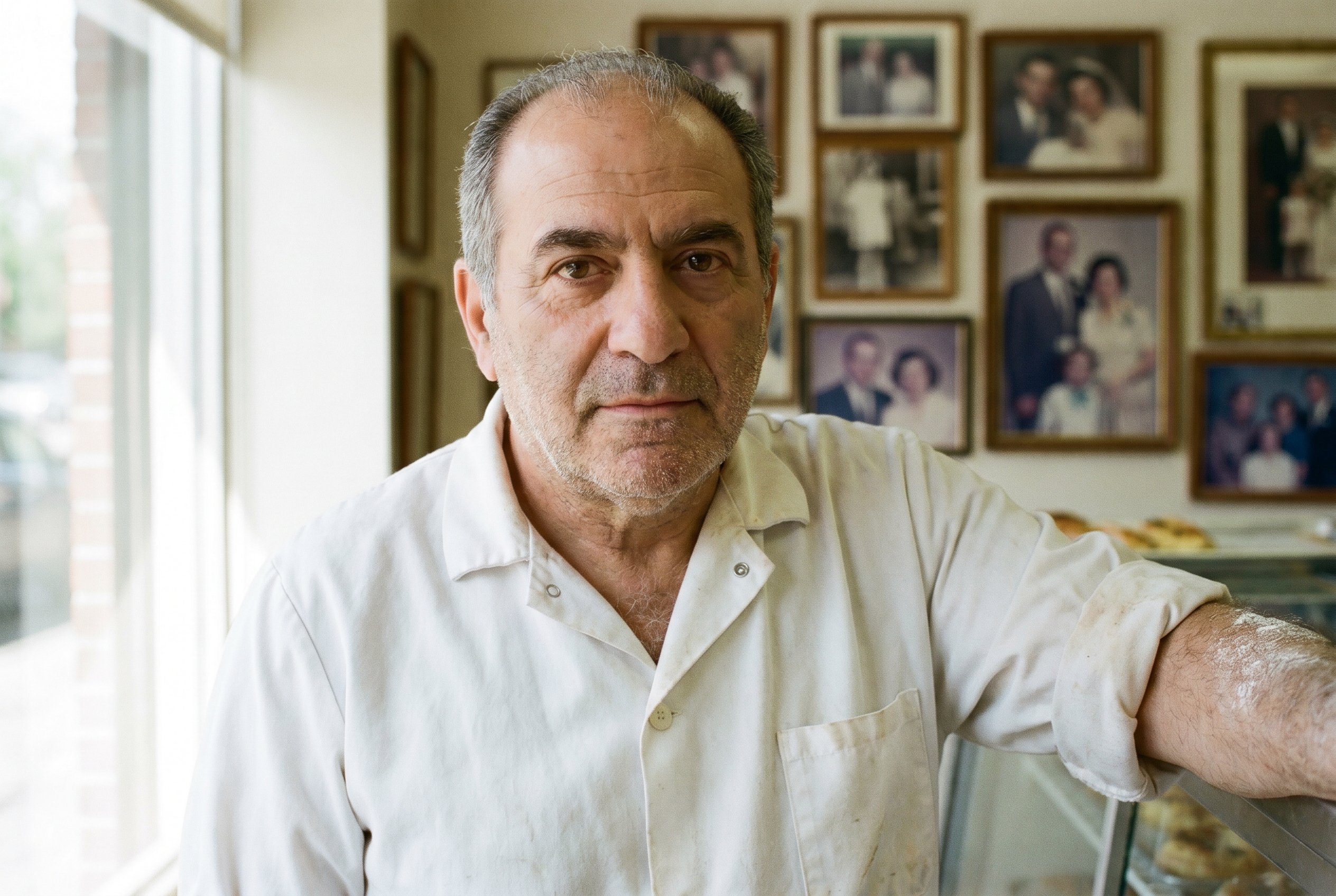
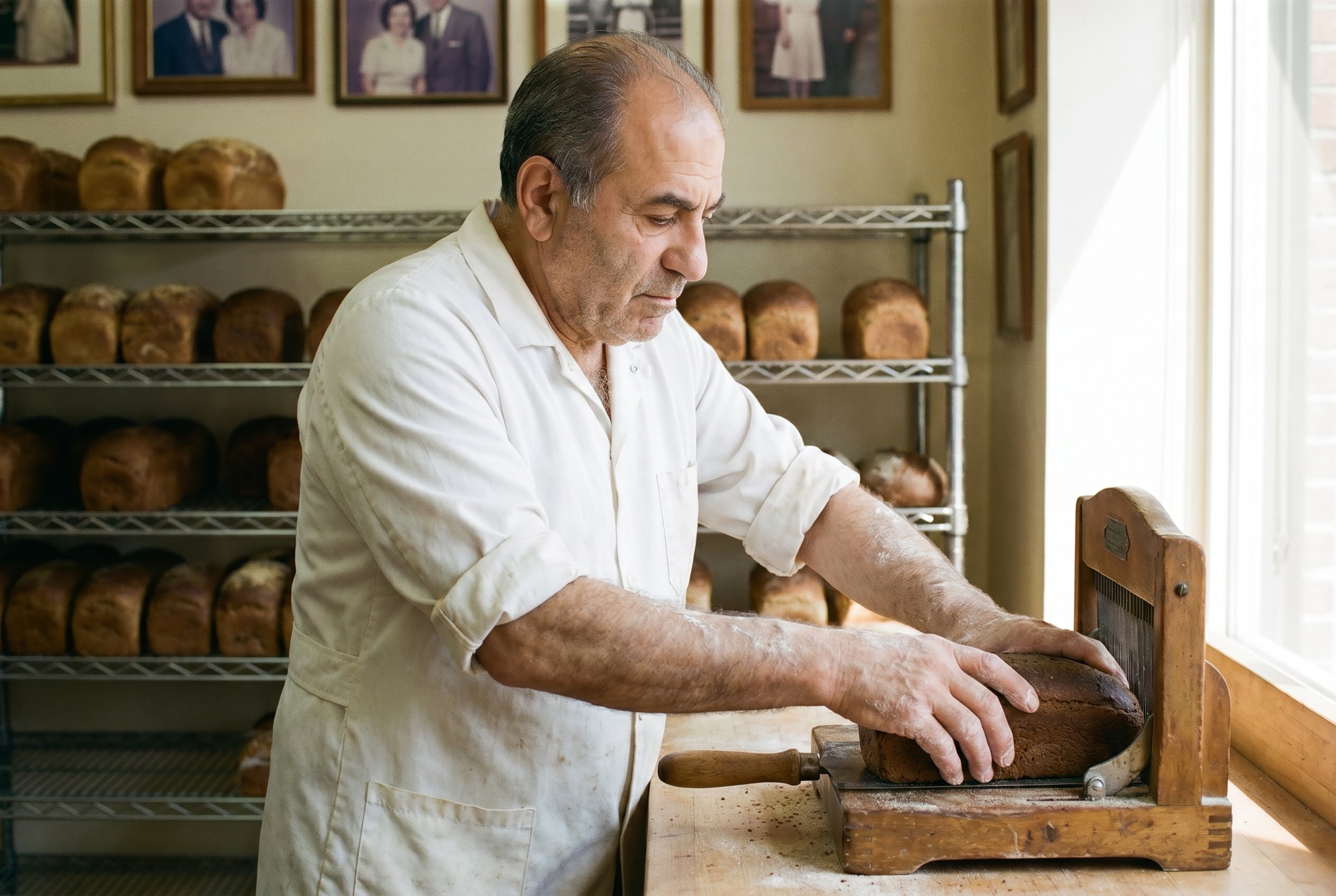
Catalog reader, saw someone on Eldridge Street this morning, behind the counter of a third-generation bakery two doors from the old synagogue. 64, third-generation Ashkenazi-Jewish-American Lower East Side multi-gen, broad chest, heavy brow, deep-set eyes, flour-dusted forearms thick as bread-tins. White cotton baker's smock buttoned high, plain dark trousers, sleeves rolled to mid-forearm. Reference depth is there. Field-Book entry NYC-Q2-LES-02. Proposal: counter-portrait plus a hands-on-the-pumpernickel-loaf detail.
Story
08:42 Eldridge Street, the bakery has been on this block since 1934. He was sliding a rye loaf onto the slicer with the practised economy of someone who has done it eleven thousand times. The slicer-blade thunks in a rhythm a notch faster than the radio, which was tuned to NPR's morning report at low volume. The customer ahead of me was an old woman in a cloth coat who asked for „the same as yesterday" and he had it bagged before she finished the sentence. When he saw me looking too long at the framed photographs above the espresso-grinder — a 1962 frame of his grandfather, a 1989 frame of his father in the same apron — he tilted his head an inch toward the wall and said, „three of us, same counter." Then back to the slicer. Reference depth here is in the slicer-rhythm, the three-of-us tilt, the radio at low.
Biografie
Saul Lefkowitz, 64. Born Lower East Side 1962, Beth Israel Hospital, raised above the bakery on Eldridge Street through the 1960s and 1970s. His grandfather Moishe arrived from a shtetl outside Łódź in 1923, bought into the bakery in 1934 as a junior partner with two cousins, was the sole owner by 1948 after the war redistributed the family. His father Bernard ran the bakery from 1971 until 2003. Saul took over in 2003 when Bernard's heart could not do the four-AM oven-shift anymore. He did the Yeshiva University accounting degree in the late 1980s because his father insisted on a profession outside the bakery, worked four years at a midtown firm, came back when his father had the first heart event. Speaks English plus enough Yiddish to handle the older customer base plus the occasional family-history conversation, conversational Spanish from forty years of delivery-and-supplier relationships, a few words of Mandarin learned from the Fujianese flour-driver. The bakery now does about thirty percent of its trade by mail-order through a website his daughter set up in 2019 — old LES expatriates ordering rye and challah to Florida, Arizona, the Catskills retirement-belt. Lives still above the bakery with his wife Miriam, a retired Brooklyn-Tech math teacher, married 1991 in the Eldridge Street synagogue two doors down. Two adult children, the daughter runs the e-commerce side from Park Slope, the son is a labour-rights attorney in Washington. Listens to NPR morning, Klezmer plus the old Mahler records his father left in the apartment evening.
Reference Depth Justification
Three substrates in one body: Ashkenazi-Jewish-American Lower East Side multi-generation diaspora with intact 1923-Łódź-to-2026-Eldridge-Street lineage through three counters, contemporary palimpsest-bakery economy that survives by combining mail-order long-tail plus walk-in old-customer base, plus the specifically-LES-multigenerational body economy that does not perform Lower-East-Side-Jewishness for tourists but simply continues it. Mednick distance is between the contemporary gentrified-LES-aesthetic that has eaten most of the block and the actual surviving three-generation craft-economy that the bakery represents. Catalog-wise this opens authentic Lower East Side Jewish-American multi-generation craft-arc that is almost extinct in working form — useful for documentary editorial, food-craft reportage, immigrant-history features, NYC palimpsest essays without the deli-tourism framing. The forearms are flour-dusted, thick, the kind of forearms a Sander or Avedon late-period frame would settle on for the work-portrait.
Catalog Category Routing
Primary: Eldridge Street third-generation Ashkenazi-Jewish-American bakery counterman, Lower East Side multi-gen palimpsest. Secondary: Material-trace forearms, three-generation bakery lineage from 1934 partnership through 2003 succession to contemporary mail-order survival economy. Editorial fit: food-craft brand documentary, NYC palimpsest editorial, Lower East Side multi-generation reportage, immigrant-history features, intergenerational-craft essays without the deli-tourism framing.
Suggested Next Step
In-situ counter-portrait with the slicer plus the wall of family-photographs visible, hands-on-the-rye-loaf detail, plus a doorway frame at the Eldridge Street entrance with the gold-leaf signage. Subject-Lock setcard refs in 4 setups: counter-portrait, hands-slicer-detail, doorway-with-signage, oven-room-with-rack. Phase 2 if consent: a Sunday morning frame with his wife at the apartment-table above the bakery would deepen the multi-generation continuity.
Prompts
Bild 1 — closeup-portrait.jpg (model: nano-banana-pro 2K)
Documentary editorial closeup portrait for a Brooklyn catalog, head-and-shoulders framing, mid-sixties third-generation Ashkenazi-Jewish-American man, broad face, heavy brow, deep-set warm-brown eyes LOOKING DIRECTLY INTO THE CAMERA LENS with quiet neutral concentration, salt-and-pepper short hair receding at the temples, salt-and-pepper close stubble, pale skin warmed by years of bakery work, plain white cotton baker's smock buttoned high at the neck, flour dust visible on the right forearm sleeve where rolled, soft natural side-light from a bakery window camera-left, the wall of family-photographs in soft fall-off behind, photographer style of August Sander work-portrait tradition, medium-format film aesthetic Kodak Portra 400, 80mm Planar compression, no jewelry, no logos, no readable signage, no readable text on the family photographs, no visible readable text anywhere in frame, no glamour retouching