Setcard NYC-2026-Q2-013 — Imran Hossain, Orchard Street second-generation Bangladeshi-American tailor
Catalog Brief
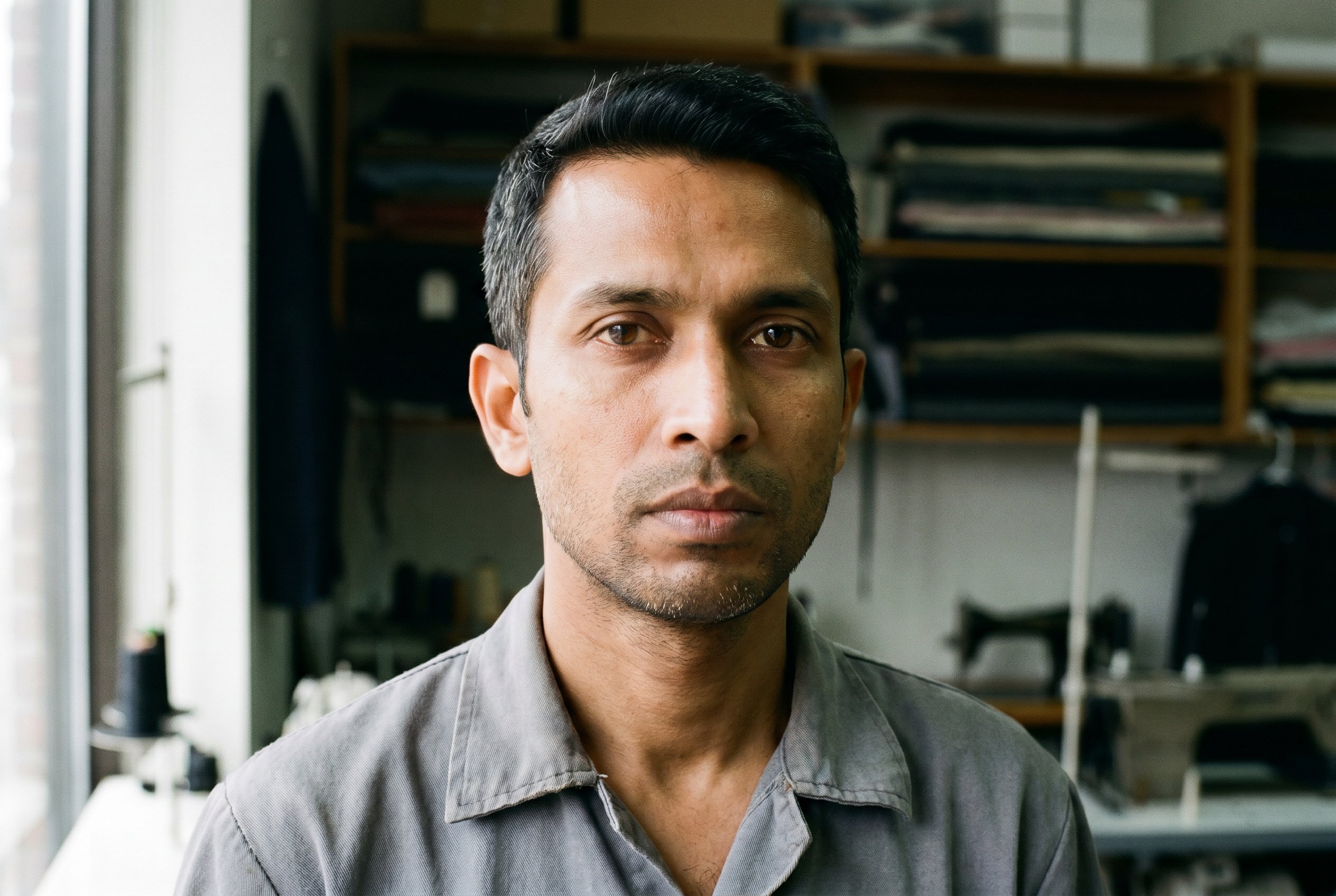
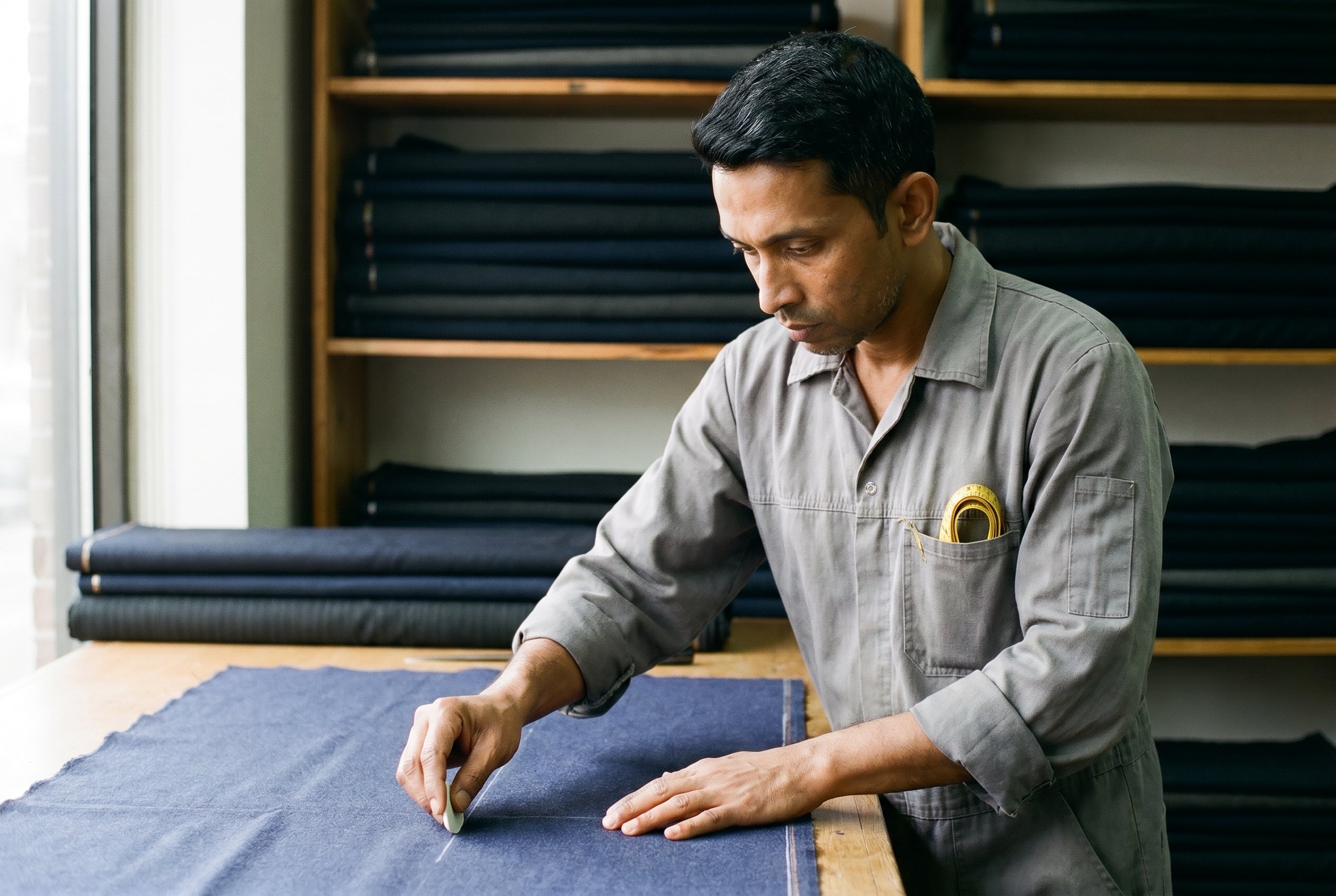
Catalog reader, saw someone on Orchard Street this morning, opening the rolling gate of a small second-floor tailor shop above a luggage wholesaler. 37, second-generation Bangladeshi-American, medium build, high cheekbones, narrow jaw, long-fingered hands that moved through the gate-lock like reading braille. Plain ash-grey work-shirt, sleeves already rolled, a yellow tape-measure folded twice in the breast pocket. Reference depth is there. Field-Book entry NYC-Q2-LES-01. Proposal: in-situ frame at the cutting-table plus a hands-detail on the scissor work.
Story
Thursday 08:14, Orchard Street, the block where the wholesale-luggage shutters still come up before the cafés. He had a key-ring with maybe fourteen keys and he used three of them in the right order without looking. The shop is on the second floor, narrow stairwell with a faded „Hossain & Son — Custom Tailoring" sign that has not been repainted since maybe 1998. Inside, the cutting-table runs along the window, bolts of indigo and dark-grey wool on the shelves behind. He waved at a man in a turban delivering a thermos of cha to the shop next door — they did not speak, just the wave plus a single sentence in Bengali that ended in a laugh. When he turned the radio on it was BBC Bangla, low volume, weather first then the news. Reference depth here is in the keys, the wave, the BBC Bangla under the cutting-light.
Biografie
Imran Hossain, 37. Born Queens (Jackson Heights) to Bangladeshi parents — his father came from Sylhet in 1981 via the family-sponsor chain to a cousin already working in the Orchard Street garment-trade, his mother followed in 1986 after the marriage was arranged across the diaspora. Grew up in Jackson Heights through the 1990s, his father commuted six days a week from 74th Street to Orchard Street on the F-train for twenty-three years until the lease on the second-floor space became transferrable. Imran came into the shop as a Saturday-helper at thirteen, full-time after the City College pattern-making certificate (2009 to 2011). The shop now does mostly bespoke shirts plus shirt-alterations for the financial-district resident class plus the older Jewish-American customers who have been coming since his father's era. Speaks English at work, Sylheti at home, polite Spanish with the building's super and the two longtime Dominican shipping clerks downstairs. Lives in Kensington Brooklyn since 2018 with his wife, a pediatric ER nurse at Maimonides, plus a three-year-old son. Listens to BBC Bangla weather-and-news in the morning, then East-Africa-routed cassette-archive Bangla-folk recordings he digitised from his father's collection — the father bought them on Atlantic Avenue in the 1990s from a Yemeni cassette-shop now gone. Carries a yellow tape-measure folded twice in the pocket, never the spool — his father's habit, „a spool catches on the doorframe."
Reference Depth Justification
Three substrates in one body: South-Asian Bangladeshi-American second-generation diaspora with intact Sylheti family-chain through Jackson Heights, contemporary Orchard Street garment-trade craft-arc continuous from the 1980s Hossain-and-Son lineage (his father's apprenticeship under an older Tunisian tailor on the same block in 1982), plus the Brooklyn-Queens-Manhattan commute-body that contemporary South-Asian-American work-life carries without ever performing it. Mednick distance is between the Orchard-Street garment-palimpsest and the Bangladeshi-diaspora craft-economy that overlays it now — a substitution that is rarely catalogued without the Bollywood-or-cab-driver tourist framing. Catalog-wise this opens contemporary South-Asian-American craft-arc in the Lower East Side garment-corridor, useful for documentary-editorial, bespoke-tailoring brand work, immigrant-craft reportage, intergenerational-NYC editorial without the model-minority simplification. Hands are long-fingered, narrow, the kind of hands a Sander or Mark Steinmetz frame would settle into for the scissor-detail.
Catalog Category Routing
Primary: Orchard Street second-generation South-Asian-American tailor, Bangladeshi diaspora multi-gen. Secondary: Material-trace hands, garment-trade lineage from 1980s Tunisian-tailor apprenticeship to 2020s bespoke-shirt economy. Editorial fit: bespoke-tailoring brand documentary, Selvedge-style craft features, immigrant-craft reportage, Lower East Side palimpsest editorial, intergenerational-NYC work without the model-minority framing.
Suggested Next Step
In-situ portrait at the cutting-table with the indigo bolt, hands-detail close-up on the scissor work, plus a doorway frame at the rolling-gate-and-stairwell. Subject-Lock setcard refs in 4 setups: cutting-table, hands-scissor-detail, gate-and-keys, BBC-Bangla-radio-window. Phase 2 if consent: a Jackson Heights Sunday-table frame with his father in the shop-archive of pattern-papers — three-generation Bangladeshi-American Orchard-Street tailor lineage would deepen the arc.
Prompts
Bild 1 — closeup-portrait.jpg (model: nano-banana-pro 2K)
Documentary editorial closeup portrait for a Brooklyn catalog, head-and-shoulders framing, late-thirties second-generation Bangladeshi-American man, high cheekbones, narrow jaw, neat short black hair with a few greys at the temples, light stubble, warm brown skin, dark-brown eyes LOOKING DIRECTLY INTO THE CAMERA LENS with quiet neutral concentration, plain ash-grey work-shirt collar visible, soft natural side-light from a tailor-shop window camera-left, dark interior fall-off behind, photographer style of August Sander craft-portrait tradition, medium-format film aesthetic Kodak Portra 400, 80mm Planar compression, no jewelry, no logos, no readable signage, no visible readable text anywhere in frame, no glamour retouching