Setcard NYC-2026-Q2-011 — Mahmud Hasan, Jackson Heights pre-dawn samosa-cart cook
Catalog Brief
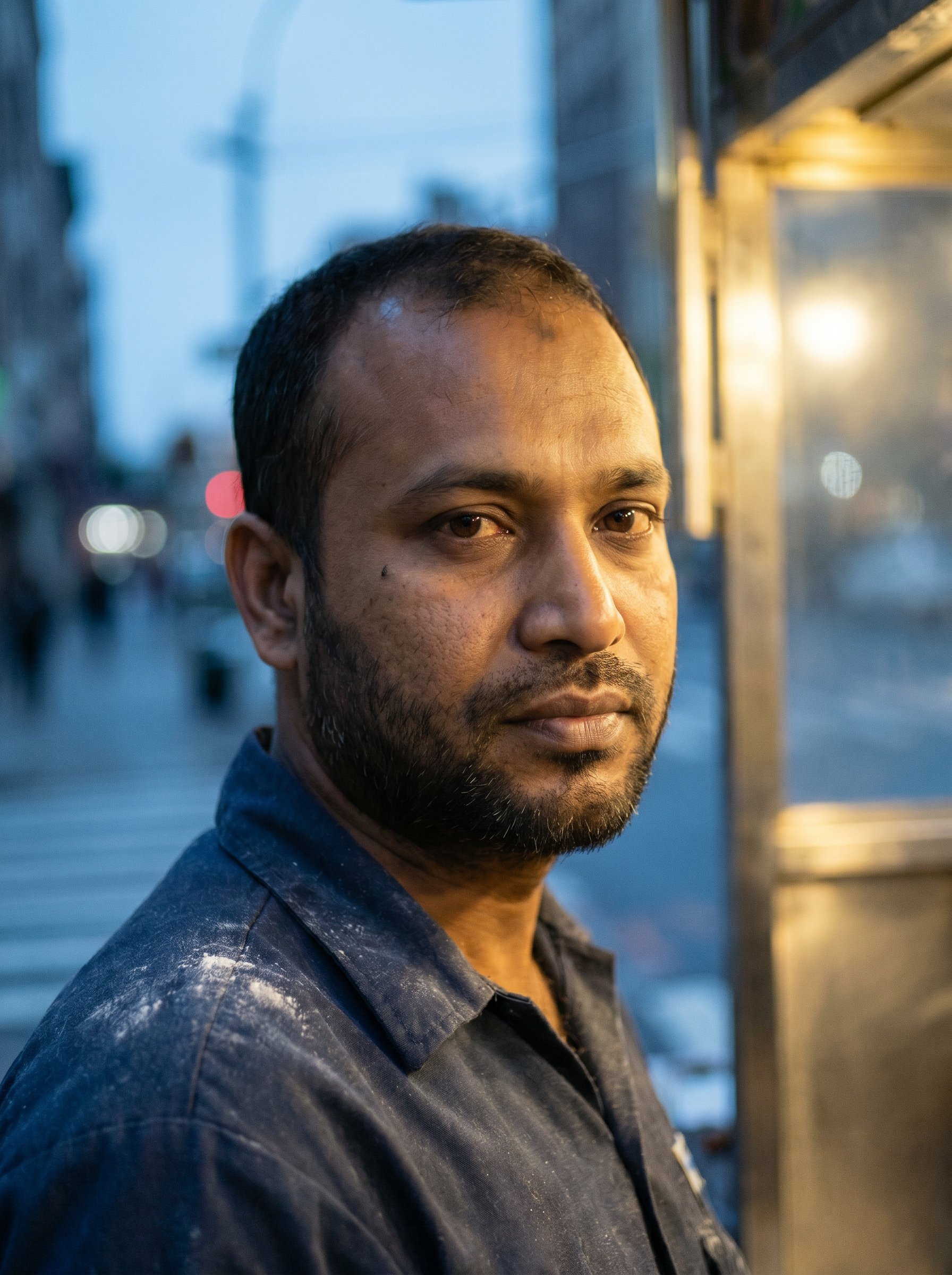
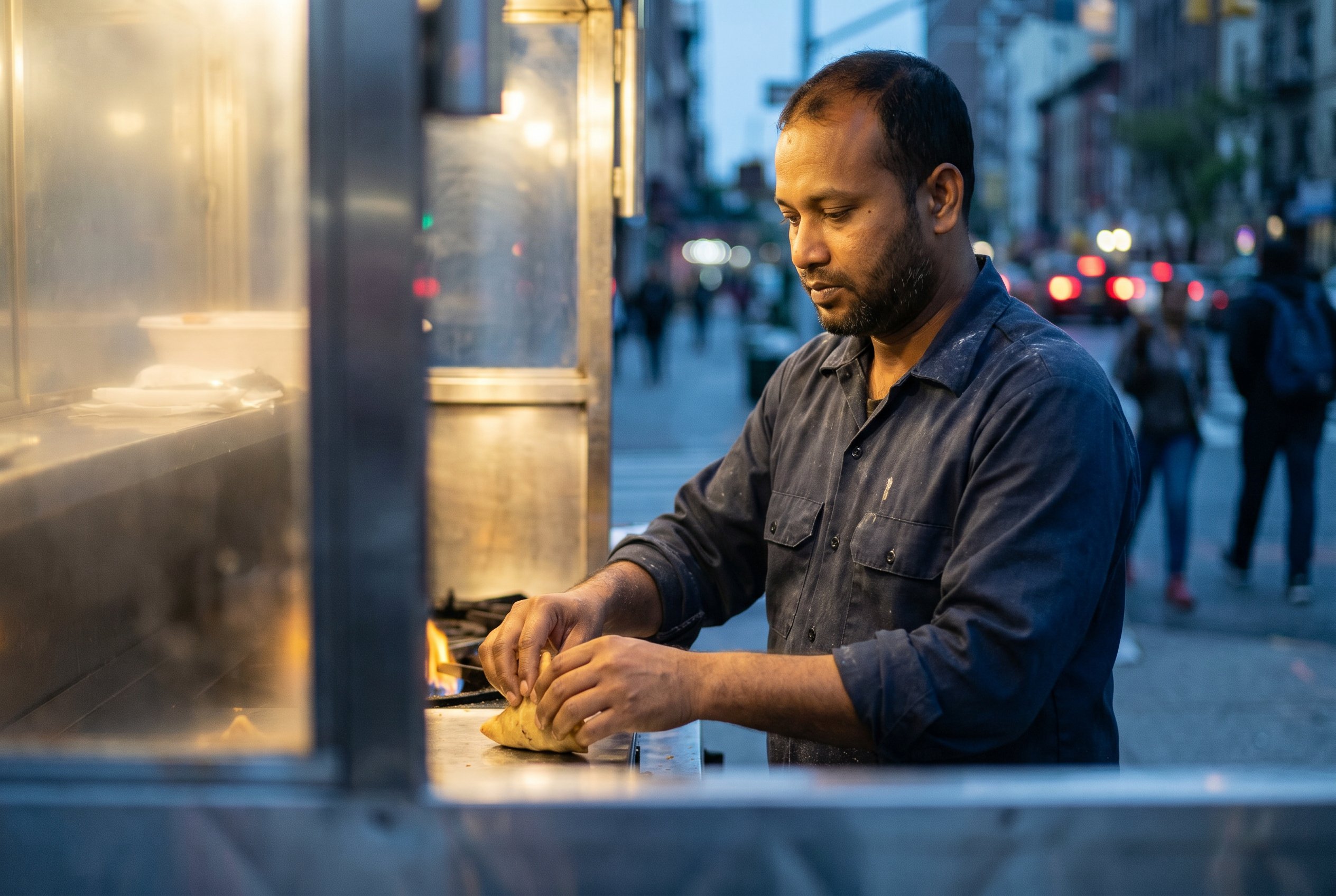
Catalog reader, walked through Jackson Heights at five in the morning today on a pre-dawn loop. 36, Bangladeshi-American first-generation, oval face with high cheekbones, dark brown eyes, slightly aquiline nose. He was working his third-shift samosa-cart on the corner of Roosevelt Avenue and 74th, the gas-burner throwing yellow light onto his hands as he folded dough. Has been running this third-shift since 2017. Reference depth is there. Field-Book entry NYC-Q2-47. Proposal: pre-dawn cart-portrait plus a hands-detail close on the dough-fold.
Story
Jackson Heights pre-dawn, the long block on Roosevelt Avenue between 73rd and 74th where the third-shift food-cart cluster runs from 11 PM to 8 AM serving the night-shift drivers and the post-mosque pre-dawn crowd. Mahmud has been on this corner since 2017 — the cart is his, the recipe is his mother's. He works from midnight to 7 AM five nights a week. He was folding samosas at 5:12 AM when I came past, the gas-burner spitting yellow light onto his hands, a fingerprint of fine wheat-flour on the shoulder of his dark navy work-shirt. He looked up, nodded, kept folding. A driver came past on a moped, called something out in Bengali, Mahmud answered without stopping the dough-fold, handed two samosas through the cart-window wrapped in plain paper, took a five-dollar bill, gave no change because they had a standing arrangement that the driver pays double on Fridays. The unceremonious-trade economy is the whole point. Reference depth here is in the steady pre-dawn dough-fold rhythm and in the standing-arrangement social-trade with the regular customer base.
Biografie
Mahmud Hasan, 36. Born Sylhet, arrived in Queens at 22 on a family-reunification visa through his older brother who had been in Jackson Heights since 2003. The family is from a small village outside Sylhet city — his father was a primary-school teacher and small landholder, his mother ran a samosa-cart at the village bazaar three afternoons a week. Mahmud was a teacher's-apprentice in Sylhet for two years before his visa came through. Worked in the kitchen of a Jackson Heights Bangladeshi restaurant from 2012 to 2017, learned the New-York-street-food economy from the inside. Bought his own cart in 2017 with a Jackson-Heights South-Asian community-loan, has run the same corner for eight years now. The cart is licensed through the New York City Department of Health. Sends a third of his earnings home to Sylhet every month for his parents and his younger sister's school fees. Married to a Bangladeshi-American hospital-administrator he met at a Jackson Heights wedding in 2019, two sons under three. Speaks Bengali at home and at work, English with the non-Bangladeshi customers, basic Spanish from years of working alongside Mexican-American cart-neighbours. Prays five times a day, the third-shift schedule built around the prayer times. Reads Bengali newspapers online, watches Bangladesh cricket matches on a small phone-screen between customers. Sleeps from 8 AM to 3 PM, picks up his sons from his mother-in-law's at 5 PM, has dinner with the family, naps from 8 to 11, then back to the cart.
Reference Depth Justification
Three worlds in one body: Bangladeshi-American first-generation Queens diaspora (intact Bengali plus the specifically-Sylheti-village-economy continuous in his mother's recipe and his monthly remittance to Sylhet), third-shift street-food material-craft on a daily-cycle (the dough-fold rhythm is the working surface, the cart license is the structural anchor), and a Jackson-Heights South-Asian micro-economy with prayer-time schedule that is a real and barely-photographed New York body-economy. Mednick distance is between Sylheti-village-food-craft and contemporary New York third-shift gig-economy. Catalog-wise this opens a category we have not had on file: Queens third-shift street-food first-generation craftsman. Useful for documentary editorial, late-night-NYC reportage, South-Asian-American diaspora briefs without curry-tourism framing, anything that needs a working face shaped by years of pre-dawn light.
Catalog Category Routing
Primary: Queens third-shift street-food first-generation, Bangladeshi-American Sylheti. Secondary: Pre-dawn working-light material-trace, intergenerational-recipe lineage. Editorial fit: Late-night-NYC documentary, South-Asian-American diaspora editorial, street-food and food-economy reportage, anything that needs a working craftsman whose schedule structures itself around prayer-times rather than around screen-time.
Suggested Next Step
Pre-dawn test-sheet at the cart plus a hands-detail close on the dough-fold plus a portrait at the cart-window with a regular customer's hand at the edge of frame (consent dependent). Subject-Lock setcard refs established. Phase 2: a daytime-rest frame at his apartment with his sons would deepen the daily-arc — needs his consent on the family side.
Prompts
Bild 1 — closeup-portrait.jpg (model: nano-banana-pro 2K)
Documentary portrait close-up, mid-thirties Bangladeshi-American man, third-shift street-food samosa-cart cook in Jackson Heights Queens, head and upper shoulders, three-quarter turn camera-left looking just past lens, oval face with high cheekbones, dark brown eyes, slightly aquiline nose, neutral closed mouth, short straight black hair, three-day stubble, mid-warm brown skin tone with slight olive undertone characteristic of Bangladeshi-American diaspora, soft pre-dawn blue-hour light from camera-right with the warm yellow spill of the cart's gas burner faintly visible on the right side of the face, plain dark navy cotton work shirt collar visible at lower edge with a single fingerprint of fine wheat-flour at the shoulder, blurred dim early-morning Queens street background with the corner of a stainless-steel food-cart in soft bokeh, mixed natural and practical light, medium-format film aesthetic Kodak Portra 400 pushed half stop for the low light, 80mm equivalent compression, no smile, no logos, no jewelry, no readable signage, calm pre-dawn working presence, photographer style of Mark Steinmetz combined with Jamel Shabazz documentary calm, no glamour retouching