Setcard NYC-2026-Q2-009 — Yonas Tesfaye, Harlem coffee-roaster
Catalog Brief
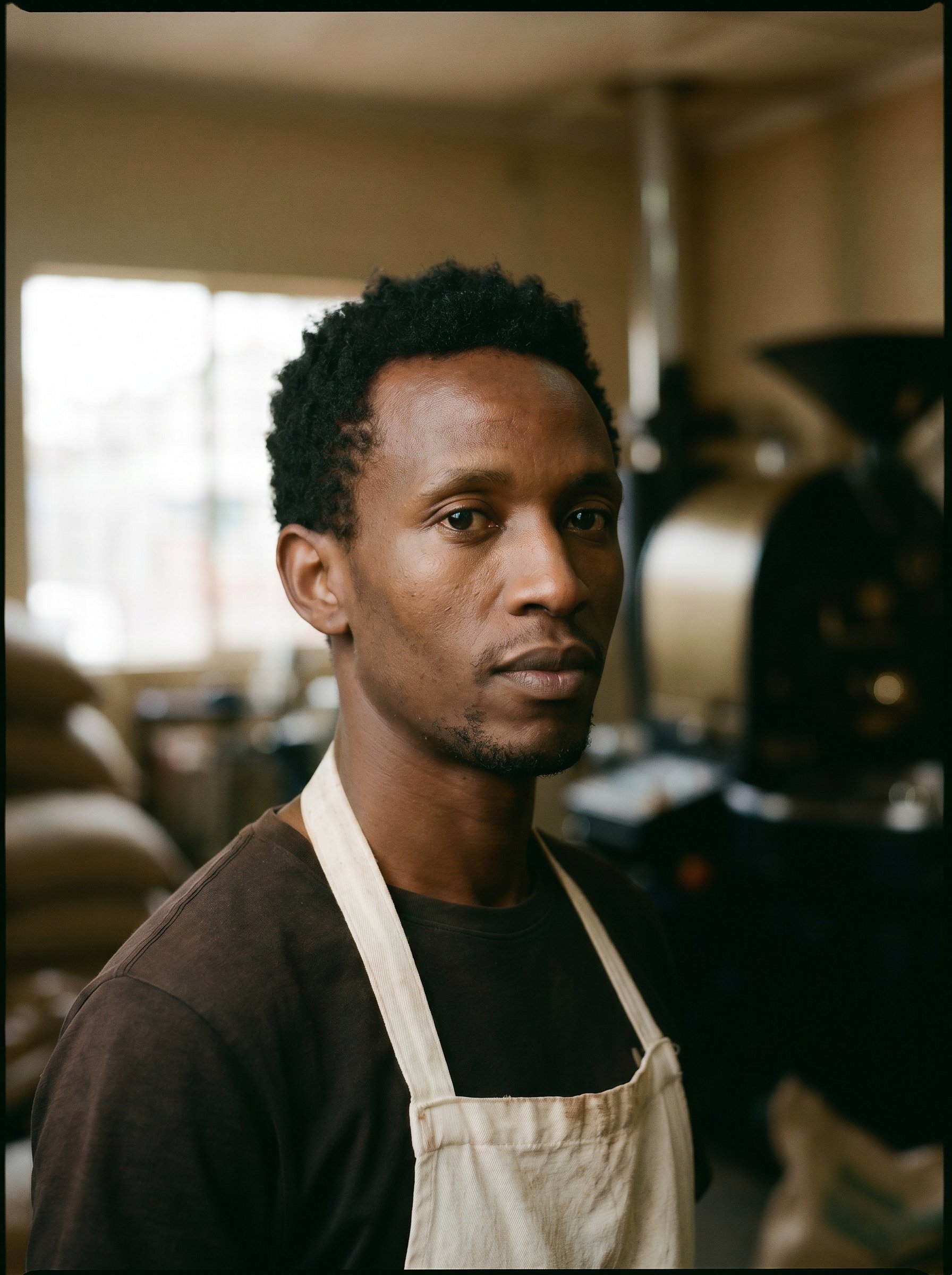
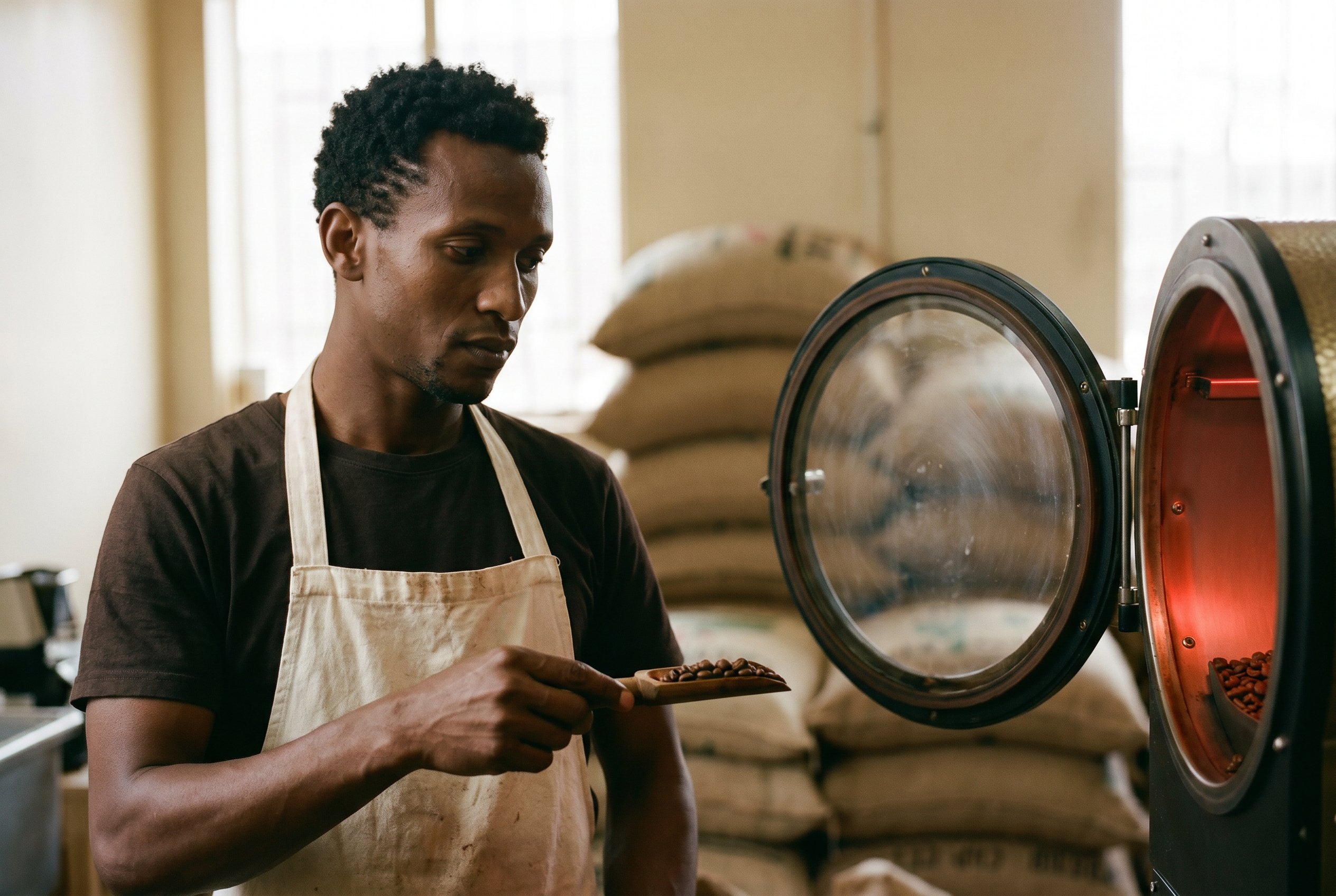
Catalog reader, walked through Central Harlem on Frederick Douglass Boulevard today, stepped into a small coffee-roastery on a side-block. 31, Ethiopian-American first-generation, narrow face with high forehead, deep-set dark brown eyes, fine bone structure. He was sampling beans from a small drum-roaster with a wooden trier, plain natural-cotton work apron, no cell-phone visible while the roast was running. Reference depth is there. Field-Book entry NYC-Q2-45. Proposal: roastery-interior portrait at the drum plus a hands-detail close on the trier and bean-sample.
Story
Frederick Douglass Boulevard mid-morning, Central Harlem the long arc between 125th and 135th where the East-African and Ethiopian-American economy threads quietly through the more-visible Caribbean and African-American small-business cluster. The roastery is on a side-block off the boulevard, no street-facing sign, the door kept open during roasting hours so the smell does the advertising. Yonas was standing at the small drum-roaster watching the bean-sample go through the second-crack window, pulled a sample with the wooden trier, smelled it, watched the colour against the inside of his palm, then opened the drum and dumped the batch into the cooling tray with the practised single motion of someone who has done this on the same machine for nine years. He didn't look up at me until the cooling-tray was spinning, then he greeted me in Amharic-accented English, asked what I was looking for. The roastery has a single regular customer base of about forty East-African families and a small Manhattan wholesale account that takes most of the medium-roast. Reference depth here is in the cooling-tray timing and in the no-phone discipline through a roast cycle.
Biografie
Yonas Tesfaye, 31. Born Addis Ababa, arrived in Brooklyn at 14 with his mother and older sister — his father came two years later through family-reunification. The family is from the Gondar region in northwestern Ethiopia, his mother's people are coffee-traders going back three generations and his father was a primary-school teacher. Public schools in Crown Heights through high school, two years at Hunter College for economics, withdrew for financial reasons. Worked as a barista at a Lower-East-Side espresso bar from 2015 to 2019, then as a roast-trainee at a Brooklyn small-batch roastery from 2019 to 2022. Opened his own roastery in Central Harlem in 2022 with a Small Business Administration loan plus a partnership with a cousin in Gondar who sources beans directly from a Yirgacheffe cooperative. The wholesale contract with the Manhattan account came eight months in — it is what keeps the roastery solvent through the slower months. Speaks Amharic at home and with most customers, English with the wholesale account, basic Tigrinya from his father's side. Married to an Ethiopian-American architect, one daughter age two. Lives in Harlem on Edgecombe Avenue, walks to work in eleven minutes. Doesn't drink, doesn't go out, prays at the Ethiopian Orthodox church on St. Nicholas Avenue every other Sunday morning. Reads Ethiopian poetry in Amharic plus business-press in English.
Reference Depth Justification
Three worlds in one body: Ethiopian-American first-generation Harlem diaspora (intact Amharic plus the very specific Yirgacheffe-coffee-trade lineage that links his roastery directly to his cousin's cooperative in Gondar — this is a documented diaspora-economic chain not a styled-import story), East-African material-craft on a long-arc (his family has traded coffee for three generations, the roasting drum is the contemporary surface of that lineage), and the Central-Harlem East-African economy which is real but barely-photographed (the Eritrean-Ethiopian-Sudanese cluster runs through the boulevard but rarely shows up in the Harlem cast lists). Mednick distance is between Ethiopian coffee-trade-lineage and contemporary New York third-wave coffee culture which uses the same beans without the same context. Catalog-wise this opens a category not on file: Harlem East-African craft-entrepreneur first-generation. Useful for documentary editorial, specialty-coffee briefs that want to honour the source-chain, East-African diaspora reportage.
Catalog Category Routing
Primary: Harlem East-African craft-entrepreneur, Ethiopian-American first-generation. Secondary: Material-trace coffee-roast, intergenerational-trade lineage. Editorial fit: Specialty-coffee documentary, East-African diaspora editorial, immigrant-entrepreneurship briefs without the rags-to-riches framing, anything that needs a craftsman whose tools are continuous with his family's three-generation arc.
Suggested Next Step
Roastery test-sheet at the drum plus hands-detail on the trier plus a portrait at the open door looking out onto the side-block (Harlem context). Subject-Lock setcard refs established. Phase 2: an Edgecombe-Avenue walk-home frame plus an Ethiopian Orthodox church-step frame to deepen the diaspora-arc.
Prompts
Bild 1 — closeup-portrait.jpg (model: nano-banana-pro 2K)
Documentary portrait close-up, early-thirties Ethiopian-American first-generation man, head and upper shoulders, three-quarter turn camera-right looking just past lens, narrow face with high forehead, fine bone structure, deep-set dark brown eyes, narrow nose, neutral closed mouth, short tightly-curled black hair, light three-day stubble, dark brown skin with warm reddish-brown undertone characteristic of Ethiopian-American diaspora, soft window light from camera-left in a small Harlem coffee-roastery, plain natural-cotton off-white work apron strap visible at the shoulder, blurred warm interior background with the shadow of a drum-roaster machine and a stack of natural-fibre coffee-bean sacks in soft bokeh, available natural light, medium-format film aesthetic Kodak Portra 400, 80mm equivalent compression, no smile, no logos, no jewelry, no readable signage, calm focused craft-roaster presence, photographer style of Malick Sidibé combined with August Sander craft-tradition, no glamour retouching