Setcard NYC-2026-Q2-007 — Juan Rafael "Rafa" Núñez, Washington Heights barber-shop owner
Catalog Brief
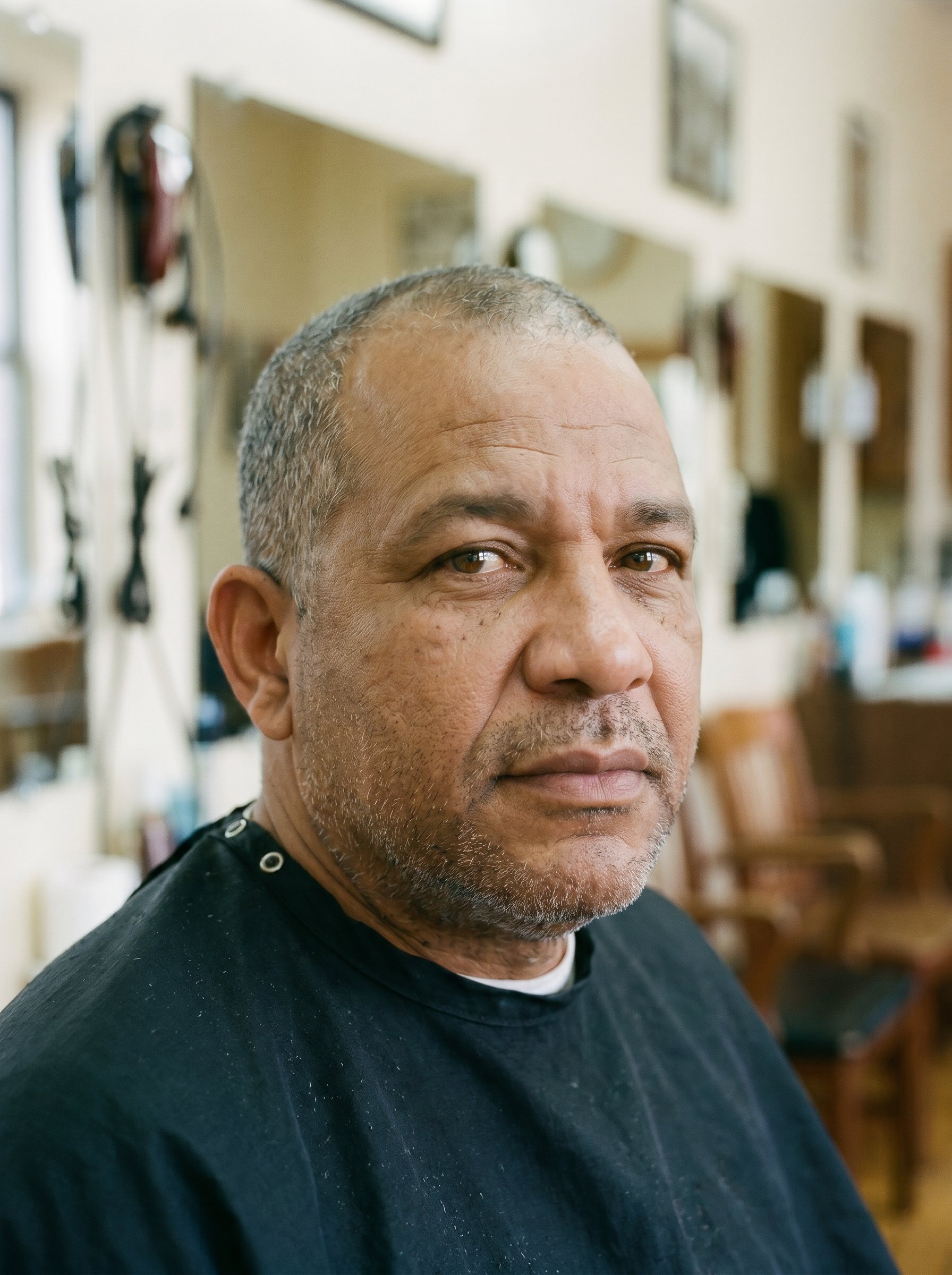
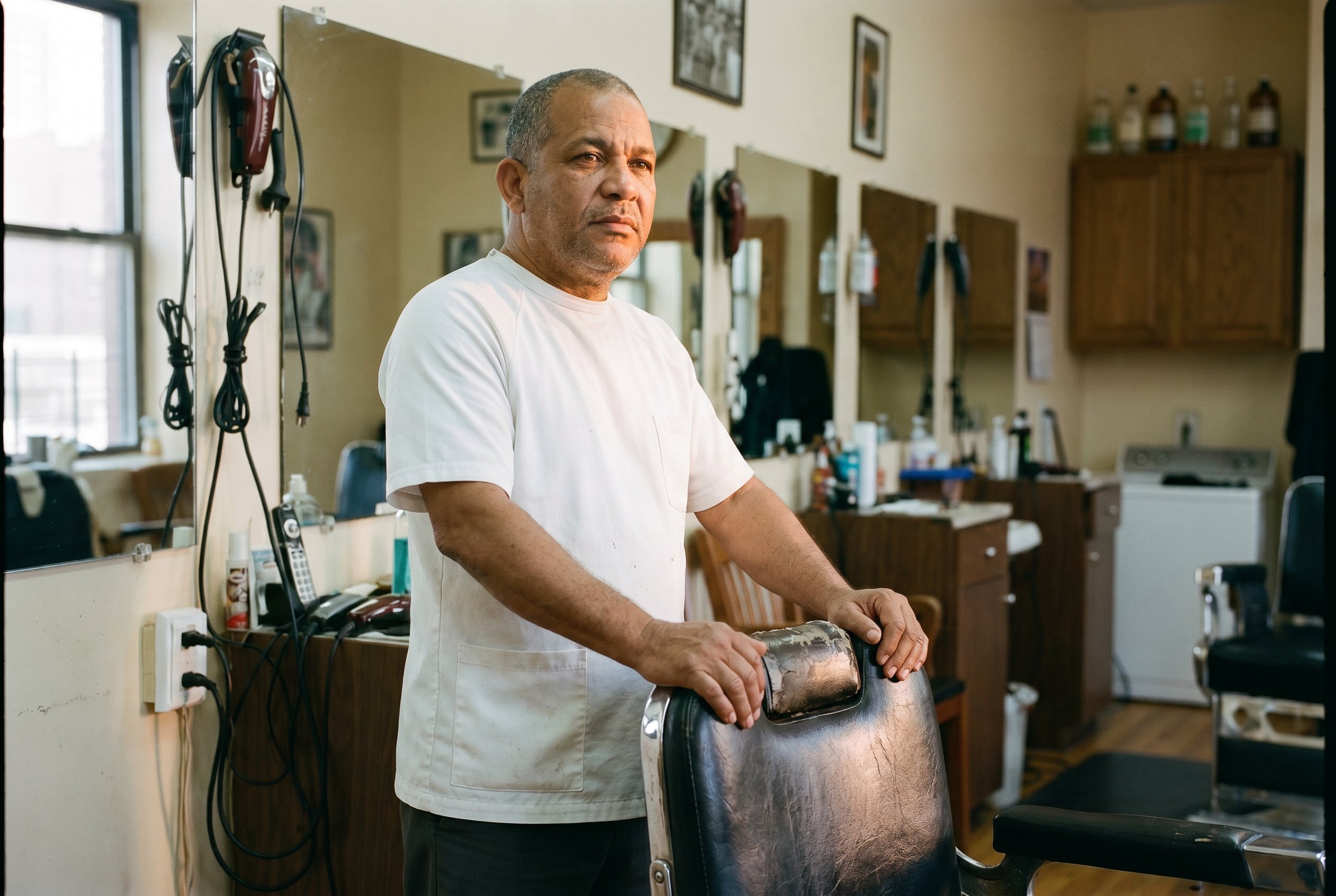
Catalog reader, walked through Washington Heights on Saint Nicholas Avenue today. 47, Dominican-American second-generation, broad face with deep nasolabial lines, dark brown eyes with crows-feet, salt-and-pepper black hair receding at the temples. Owns the barber-shop on the corner since 2001 — twenty-five years of standing behind the same chair, the chrome arm-rests worn smooth on the customer side. He talked to a regular for eleven minutes in Spanish about a grandson's first communion before the customer ever sat in the chair. Reference depth is there. Field-Book entry NYC-Q2-43. Proposal: shop-interior portrait behind the chair plus a hands-detail close on the clipper-hand.
Story
Saint Nicholas Avenue mid-afternoon, the long block where the third-generation Dominican-American economy still anchors most of the storefronts before the avenue tips up toward Fort George. The barber-shop has been on the corner since his father opened it in 1989 — Rafa took it over in 2001 when his father went back to Santo Domingo for the last seven years of his life. The interior is unchanged since he took over: four leather chairs all original, a long mirror-wall on the north side, a row of plain-glass tonic bottles on a wood shelf that he refills himself. A regular came in, sat at the bench in the corner first, talked with Rafa about a grandson's first communion for eleven minutes before either of them moved toward the chair. The talking is the haircut, the haircut is the talking — that ratio is the actual trade. Reference depth here is in the broad face that has been watching this avenue for almost five decades and in the steady hand that has clipped through three economic cycles without raising the price faster than the rent.
Biografie
Juan Rafael "Rafa" Núñez, 47. Born Washington Heights, raised on the same block as the shop. Father arrived from Santiago de los Caballeros in 1975 as a barber's apprentice in a Manhattan menswear chain, saved for fourteen years, opened the shop in 1989. Rafa started sweeping the floor at nine, learned the clippers at thirteen, started cutting paying customers at sixteen with his father standing behind him. Two semesters at Bronx Community College for accounting in his early twenties, didn't finish — took the shop over in 2001 when his father's health turned. Has owned it now for twenty-five years, has not raised the basic-cut price faster than the rent in any of those years. Married to a Dominican-American teacher he met at a Cuchifritos lunch counter in 2003, three children, the oldest is now studying nursing at City College, the middle one apprenticed in the shop on weekends. Goes back to Santiago de los Caballeros once a year for ten days in August. Speaks Spanish at home, English with younger customers, mixes both with everyone over forty. Reads the Sunday Times in English plus El Diario in Spanish, never both on the same day. Catches the Dominican baseball league on a small TV mounted in the corner of the shop on Tuesday nights.
Reference Depth Justification
Three worlds in one body: Dominican-American second-generation Washington-Heights diaspora (intact Spanish plus the bicultural-economy that holds the long-block storefronts together), service-trade material-craft on a quarter-century arc (his father's shop continuous since 1989, no renovation cycle has interrupted the trade), and the talking-as-haircut social-trade that is the actual product of a real neighbourhood barber (not a Brooklyn Williamsburg curated experience). Mednick distance sits between the Dominican-American small-business lineage and the contemporary New York third-place economy that increasingly excludes it. Catalog-wise this opens a category we have not had on file in NYC: Manhattan-Heights service-trade second-generation proprietor with a deep block-recognition body economy. Useful for documentary briefs, generational-economy reportage, anything that needs a face shaped by listening more than by being looked at.
Catalog Category Routing
Primary: Washington-Heights service-trade proprietor, Dominican-American second-generation. Secondary: Long-arc craft-hands, four-decade block-continuity. Editorial fit: Documentary editorial, generational-trade reportage, workwear and trade-uniform briefs, anything that needs a man who has been standing in the same room for twenty-five years.
Suggested Next Step
Shop-interior test-sheet at his chair plus hands-detail on the clipper-grip plus a window-portrait of the avenue from inside the shop looking out. Subject-Lock setcard refs already established with closeup plus behind-the-chair context. Phase 2: full sheet in summer-light when the avenue traffic feeds the window.
Prompts
Bild 1 — closeup-portrait.jpg (model: nano-banana-pro 2K)
Documentary portrait close-up, late-forties Dominican-American second-generation barber-shop owner, head and upper shoulders, three-quarter turn camera-right looking just past lens, broad face with deep nasolabial lines from decades of laughing with customers, dark brown eyes with crow's-feet, neutral closed mouth, short salt-and-pepper black hair receding at temples, three-day stubble graying at the chin, mid-brown skin with warm undertone, soft window light from camera-left in a Washington Heights barber-shop interior, plain white short-sleeved barber tunic collar visible at lower edge, blurred warm interior background with rows of mirrors and clipper-cords in soft bokeh, available natural light, medium-format film aesthetic Kodak Portra 400, 80mm equivalent compression, no smile, no logos, no jewelry, no readable signage, calm confident proprietor presence carrying twenty-five years of the shop in the face, photographer style of August Sander craft-tradition combined with Dawoud Bey, no glamour retouching