Reinhard Patzelt, 72, Berlin-Lichtenberg — Forty-Year East-Berlin Tram Driver, WBS-70 Plattenbau on Frankfurter Allee, Widower Since 2021
Identity Block
- Name: Reinhard Patzelt
- Gender: male
- Age: 72
- Ethnicity: White East-German (Lichtenberg-born 1954, DDR biography)
- Base: Berlin, Germany
- Metro-Tag: berlin
- Cluster-Tag: berlin-lichtenberg-ddr-verkehrsbetriebe-tram-driver-wende-widower-elder
Catalog Brief
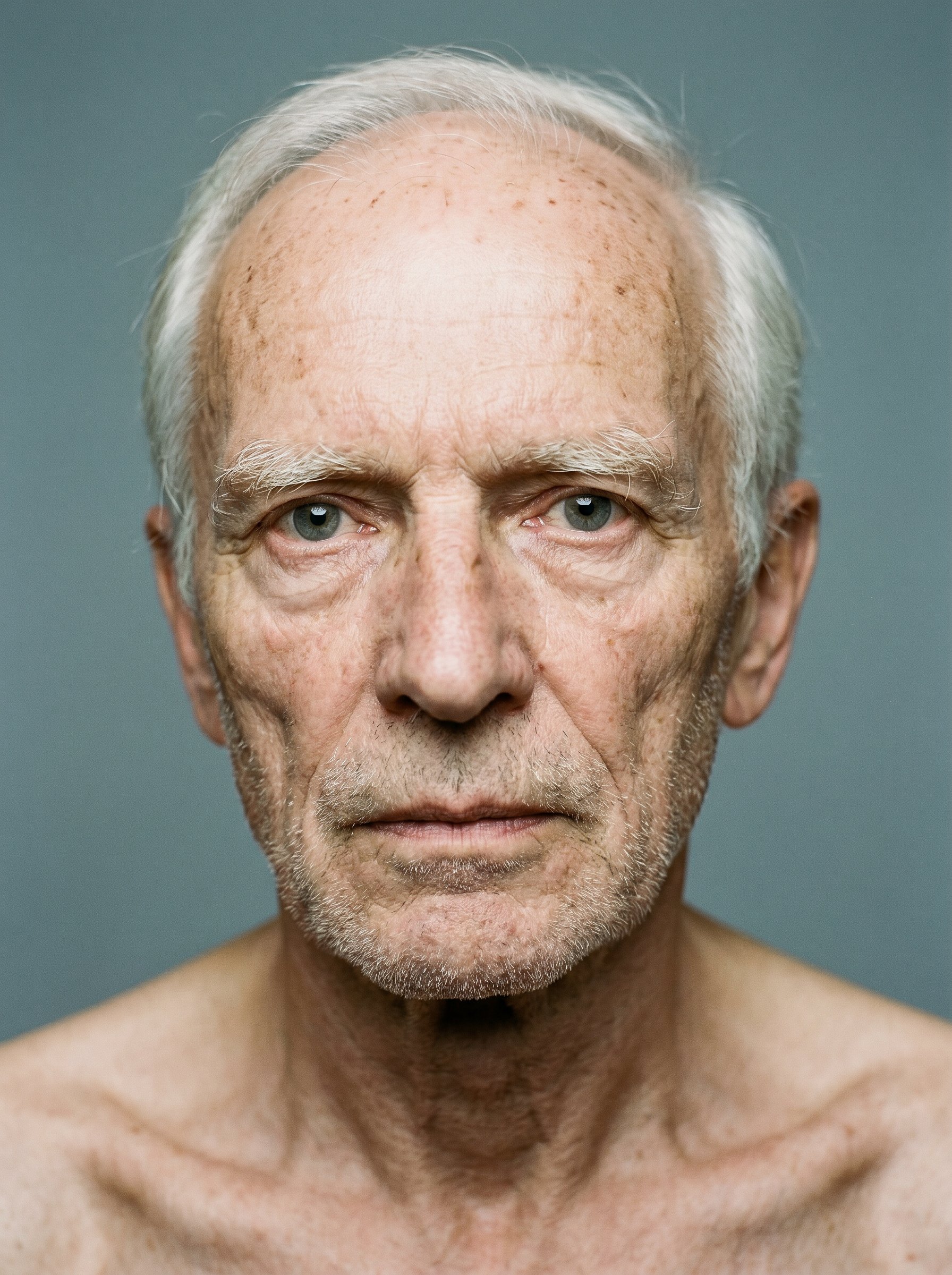
Catalog reader — Lichtenberg, a tram stop on Frankfurter Allee at dusk, early-seventies (born 1954 in Lichtenberg, drove the East-Berlin tram lines forty years, 1974 to 2014, through the BVB-to-BVG merger of the Wende without changing depot). Long pale papery face, sunken cheeks under high flat cheekbones, the specific stillness of a man who braked for a living and learned not to waste a movement. Deep-set pale grey-blue eyes under heavy drooping lids, the lower rims pink and loose with age. Sparse white hair combed straight back from a high freckled forehead, the scalp showing through. Bushy white brows, one held a little higher than the other, a permanent dry scepticism. Grey stubble across a thin jaw, the throat folded and the tendons standing out, the collarbones sharp. He waits at the stop upright, both feet square, the way you stand when standing still has been your whole working posture. Reference depth strong on four layers: the DDR-Verkehrsbetriebe tram-driver body (forty years reading the same rails — this is a documentary East-Berlin Werker face, not a generic pensioner), the Wende-transition carried in one biography (drove for the BVB before 1992 and the BVG after, same Betriebshof, system-change without job-change), the WBS-70 Plattenbau on Frankfurter Allee he has lived in since 1979, and the solitary-elder-widower stillness since his wife Christa died in 2021. Field-Book entry BER-2026-Q2-045. Suggested next step: anchor-card for a Berlin-East-DDR-Werker-Biography-Senior cohort the Catalog has barely touched — the East-German working face of the generation that drove, welded and dispatched the GDR city and then kept living in it.
Story
Lichtenberg, Frankfurter Allee, just past seven in the evening. Blue hour. The Plattenbau across the road had half its windows lit, the other half dark in that even Plattenbau grid.
I had not gone looking for Reinhard. He was simply standing at the tram stop, alone, while three younger people stared into their phones, and he was the only one watching the rails.
The tram came in — yellow, modern, quiet — and he did not move toward it. He let it go. He was not waiting for that one, or he was not waiting for any. I asked, the way you ask, whether the next one was his.
Ich warte nicht auf die Bahn, he said. Ich gucke nur, ob sie richtig fährt. — I'm not waiting for the tram. I'm just checking it runs right.
Forty years he drove these lines. 1974 he started, twenty years old, on the Ost-Berliner Straßenbahn. Linie einundzwanzig, dann andere. Ich kannte jede Schiene mit geschlossenen Augen. Wo sie quietscht, wo sie eng wird, wo der Bremsweg länger ist im Nassen.
I asked about the Wende. He let a tram-length of silence go by.
Bis zweiundneunzig BVB, dann BVG. Gleicher Hof, gleiche Schienen, neuer Name auf der Lohntüte. Manche haben es schwer gehabt. Ich hatte Glück — ich durfte weiterfahren. Fahren konnte ich ja. Das haben sie gebraucht, egal welche Fahne.
He retired in 2014. Christa, his wife, died in 2021. The son is in Munich, has been since the nineties. Er ruft sonntags an. Ist gut so. — he calls on Sundays. That's fine.
I asked why he still comes to the stop in the evening if he isn't going anywhere.
He looked at the rails, not at me. Vierzig Jahre habe ich Leute nach Hause gefahren. Jetzt gucke ich, dass die Bahn sie noch richtig hinbringt. Alte Gewohnheit. Schadet keinem. — Forty years I drove people home. Now I check the tram still gets them there right. Old habit. Hurts no one.
The next tram came. He watched it brake, watched it pull, gave a single small nod — the brake was clean — and only then turned to go up to the flat.
Biografie
- Born 1954 in Berlin-Lichtenberg. Father Werner Patzelt (1928), Reichsbahn track-worker; Mother Ilse Patzelt (1931), Verkäuferin in a Konsum.
- Grew up in an Altbau on Pfarrstraße, Lichtenberg; Polytechnische Oberschule to the 10th class, finished 1970.
- Trained as Facharbeiter für Verkehrstechnik 1970–1973.
- Began as a Straßenbahnfahrer for the VEB Kombinat Berliner Verkehrsbetriebe (BVB) in 1974, age twenty, out of the Betriebshof Lichtenberg.
- Married Christa Patzelt (née Lorenz, 1955) in 1976.
- Moved into a new WBS-70 Plattenbau flat off Frankfurter Allee in 1979 — the flat he still lives in.
- One son, Andreas (1980), Berlin-born; moved to Munich for work in 1994 after an apprenticeship, stayed.
- Drove continuously through the 1990 reunification and the 1992 BVB–BVG merger — same depot, same lines, new employer name.
- Retired from the BVG in 2014 after forty years of driving, no major accident on his record.
- Christa died of cancer in 2021. Reinhard kept the flat, lives alone, has not moved.
- Walks to the Frankfurter Allee tram stop most evenings; the depot crowd from his years has thinned to a handful he still meets for a beer at a Lichtenberg Eckkneipe.
Reference Depth
Four layers, all readable in the face, the posture and the biography — and all pointed at a cohort the Catalog has barely opened: the East-German working-elder.
First layer — the forty-year DDR tram-driver body. Reinhard drove the East-Berlin tram from 1974 to 2014, out of the Betriebshof Lichtenberg. Forty years of the same seated, braced, attentive working posture leaves a specific body — the economy of a man who learned never to waste a movement at the controls, who reads a moving thing for a living and goes still around it. This is a documentary East-Berlin Werker face, distinct from a generic pensioner and distinct from the West-Berlin equivalents — the GDR transport-Werker substrate is its own lineage.
Second layer — the Wende carried in one biography. He drove for the VEB BVB before 1992 and for the BVG after, from the same depot, on the same rails. The system-change runs straight through his working life without a job-change: new name on the pay-packet, same brake-pedal. That is a documentary-grade Wende-Werker case — the man who simply kept driving because driving was needed under any flag.
Third layer — WBS-70 Plattenbau continuity since 1979. He moved into the Frankfurter Allee Plattenbau new in 1979 and never left it — through reunification, retirement and widowerhood. Forty-seven years in one prefab flat is East-Berlin residential continuity of a kind that is quietly disappearing as the generation thins. The Plattenbau is not backdrop; it is the same substrate as the man.
Fourth layer — the solitary-elder widower stillness. Christa died in 2021; the son is in Munich; the depot cohort has thinned. The evening habit of going down to the stop he no longer needs — to watch the tram brake clean — is the layer that makes him a person and not a type: forty years of taking people home, continued now as a private, useless, dignified vigil.
Subject-Lock-Workflow: Establishing-Portrait Naked-Base refs=[] (generated 2026-06-08, 3:4 v3.2 norm), then Scene at the Frankfurter Allee tram stop with the Establishing as reference. Visual-anchor-tokens for Subject-Lock continuity: the high freckled forehead with the pink scalp through sparse white hair, the one-raised bushy white brow, the slight leftward bend in the thin nose, the pale grey-blue deep-set eyes, the standing tendons in the thin throat.
Brand Route
Documentary-Editorial primary — 032c Berlin-East-DDR-Werker-biography-cohort, Mono.Kultur Wende-Werker-continuity-documentary, ZEITmagazin Ost-Berlin-Plattenbau-elder-portrait, Süddeutsche-Magazin GDR-transport-Werker-lineage. Possible quiet-luxury cross-bracket only where the register stays honest — an ageing-with-dignity campaign that does not sentimentalise the East. Anti-Ostalgie-kitsch, anti-poverty-frame, anti-novelty-pensioner. Photography lineage: August Sander Menschen-des-20-Jahrhunderts working-type spur, Helga Paris Berlin-Ost portraiture, Ute Mahler / Werner Mahler East-German documentary face, Sibylle Bergemann Berlin substrate.
Suggested Next Step
Return to the Frankfurter Allee stop on a clear evening for a second frame — a wide environmental shot with the full WBS-70 facade and a tram in motion behind him, the man small against the architecture he served. If he agrees to a third slot, the Lichtenberg Eckkneipe with the two or three remaining depot-colleagues would carry the cohort outward into a group-frame. Cross-bracketing: a future BER-Reichsbahn-track-worker-second-generation card (his father's lineage), and a future BER-East-Berlin-Plattenbau-widow card as the female counterpart to the solitary-elder layer. Consent note: the son in Munich should be left out of any public framing unless Reinhard raises him; the widowerhood is in the story only because Reinhard offered it plainly, not as pathos.
Field-Book Note: the Berlin-East-DDR-Werker-Biography-Senior cohort is an open axis — the generation that drove, welded and dispatched the GDR city and then kept living in it. Reinhard is a clean documentary anchor for the transport-Werker branch.
Establishing Portrait
This is the full 100%-from-text Establishing-Portrait used for establishing-portrait.jpg. Refs=[] strictly per the Naked-Base directive, 3:4 v3.2 Noah-norm.
Model: nano-banana-pro (gemini-3-pro-image-preview), 2K, 3:4 aspect, references empty.
Editorial medium format photography, 3:4 vertical portrait format. Tight head and shoulders Noah-style crop, the head filling the upper two-thirds, eyes about one third from the top, frame ending at the upper-shoulder line just below the collarbones with the full crown inside the frame and no chest visible, body near-frontal with shoulders square and eyes locked to the lens, soft diffused daylight from camera-left, clean cool-leaning mid-grey studio sweep, explicitly not warm or beige. Reinhard Patzelt, seventy-two, a white East-German man born in Lichtenberg in the early nineteen-fifties, a tram driver on the East Berlin lines for forty years. A long, narrow face gone pale and papery, the cheeks sunken below high flat cheekbones. Pale grey-blue eyes set deep under heavy drooping upper lids, the whites faintly yellowed, the lower rims pink and loose with age. A thin sharp nose with a slight leftward bend from an old break. Sparse white hair combed straight back from a high freckled forehead, the scalp showing pink through it. Bushy white brows, one slightly raised as if permanently sceptical. Deep vertical lines bracketing a thin straight mouth, the lower lip narrow and bloodless. Grey stubble across the jaw and the loose folds of the throat. The neck is thin, the tendons standing out, the collarbones sharp under papery skin. Liver-spots scatter the temples and the high forehead. No clothing of any kind appears anywhere in the frame. Kodak Portra 400 fine grain, naturalistic pale ageing skin tone with full pore-texture and no smoothing, no airbrush, no waxy sheen, no text overlays, no logos.
Scene

Prompts
Bild 1 — establishing-portrait.jpg (model: nano-banana-pro 2K, 3:4, references empty) — full prompt verbatim under the Establishing Portrait section above.
Bild 2 — scene-tram-stop.jpg (model: nano-banana-pro 2K, 3:4, references=[establishing-portrait.jpg]) — Documentary medium format photograph, 3:4 vertical. The exact same man as in the reference image, identical face, long pale papery features, deep-set pale grey-blue eyes under drooping lids, sparse white hair combed straight back from a high freckled forehead, bushy white brows, grey jaw stubble — Reinhard Patzelt, seventy-two, a retired East Berlin tram driver. He stands waiting at a modern tram stop on Frankfurter Allee in Lichtenberg at blue dusk, wearing a plain dark-grey zip cardigan over a worn shirt, a canvas shopping bag at his side. Behind him a yellow Berlin tram slides through in motion blur, the long grey WBS-70 Plattenbau facade and its lit windows rising into soft focus. Cold even evening light, faint sodium glow from the platform lamp. He looks straight to the camera, upright and composed, the man who drove these rails for forty years now waiting at the stop like anyone else. Quiet, documentary, lived-in. Naturalistic ageing skin with full pore-texture, Kodak Portra 400 fine grain, no smoothing, no airbrush, no text overlays, no logos.