Catalog Brief
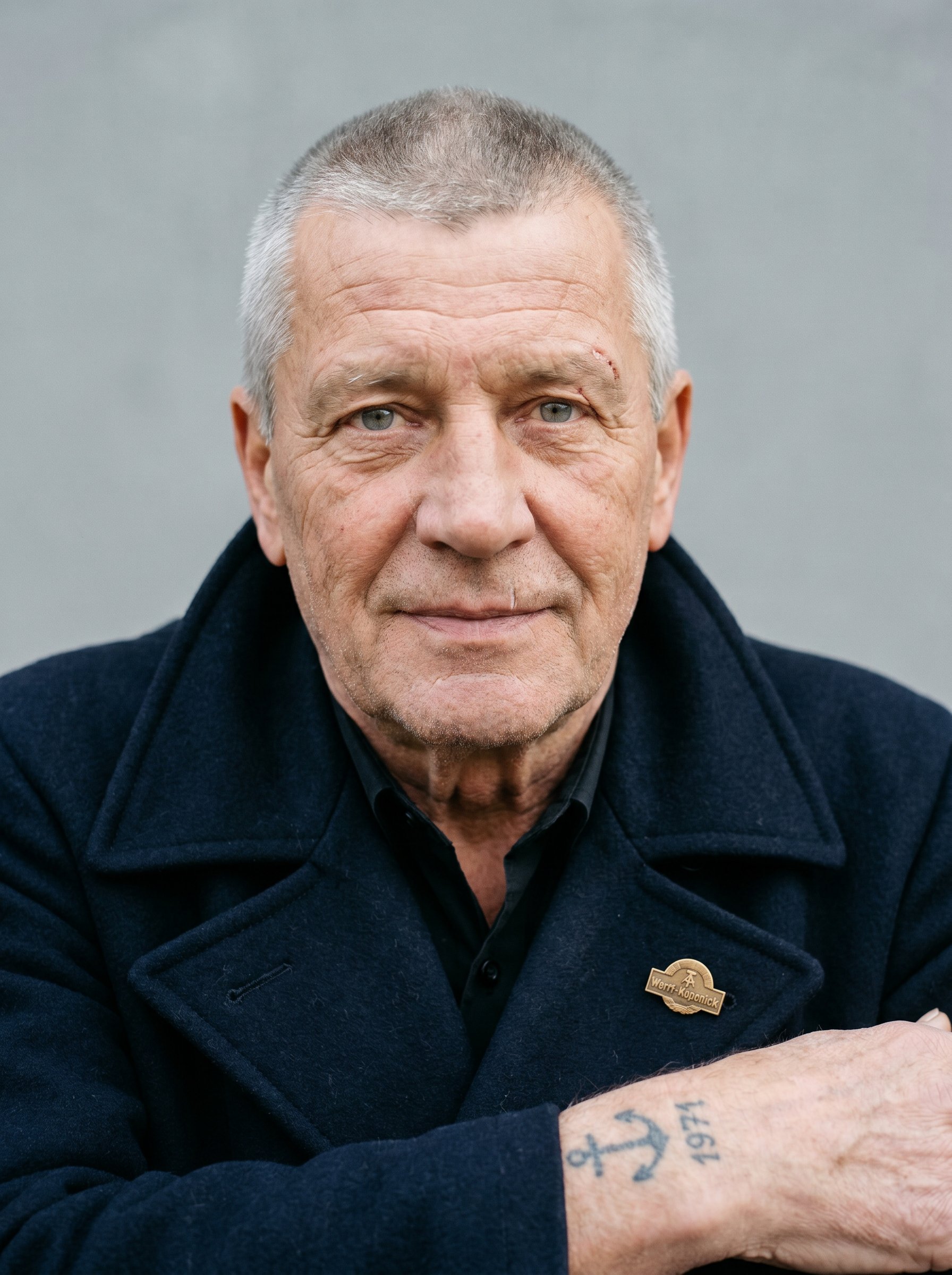
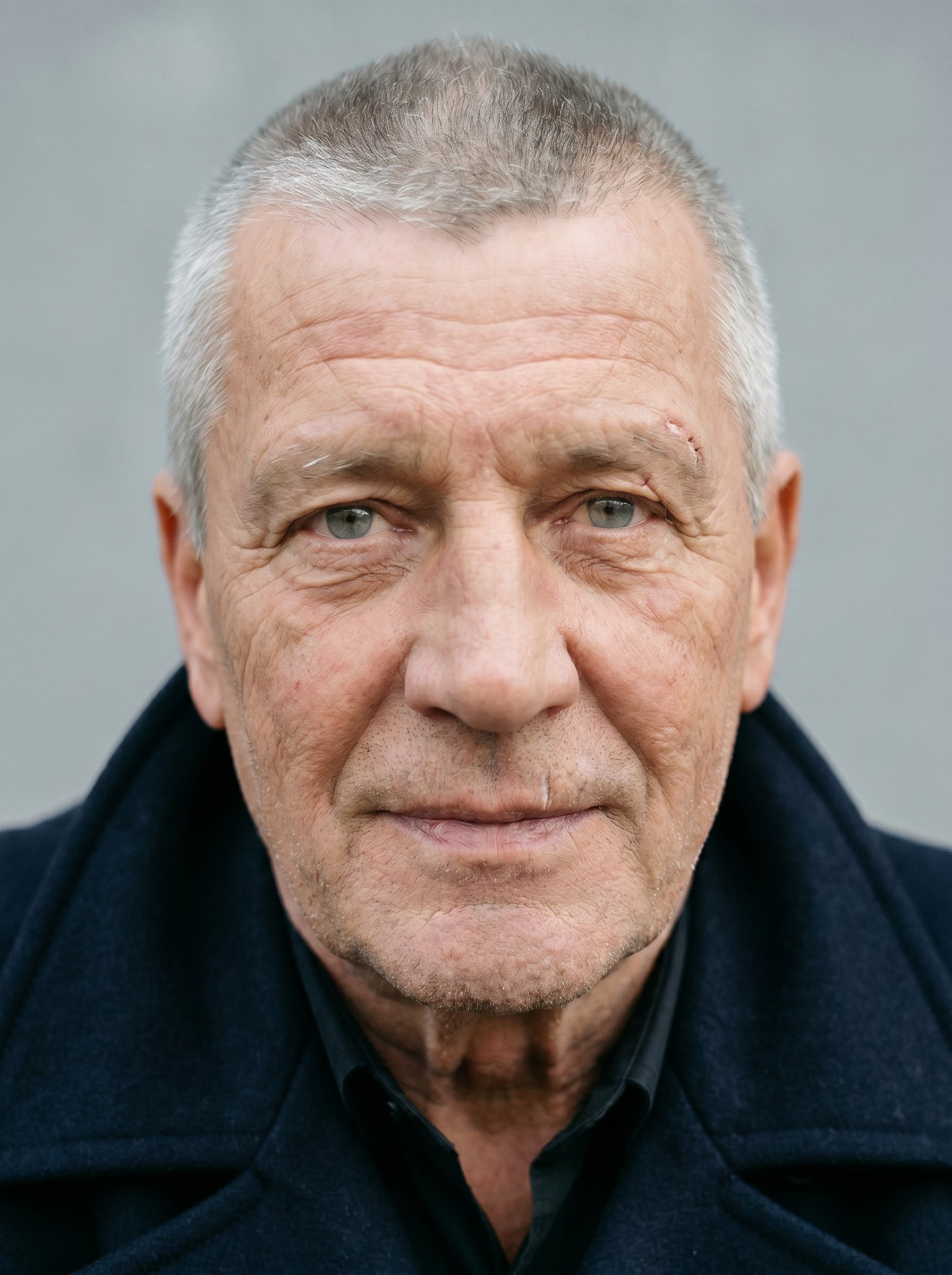
Catalog reader, today on a Thursday-late-afternoon in Berlin-Köpenick I sat for forty-five minutes with Hartmut Wenzel, 76, called Hatz by everyone at the table, GDR Volksmarine 1968–1971 plus Schweißer-then-Vorarbeiter at the Köpenicker Werft 1971–1992, retired 2014 after twenty-two further years of post-Wende sub-contract metalwork. Weathered pale skin with deep wind-tan across the cheekbones, crew-cut steel-grey hair military-trim, a small white welding-spark scar from 1979 near the right eyebrow. The thing that carried: on the left inner forearm a faded blue-black single-line anchor-and-welding-seam tattoo with the year 1971, applied in Rostock during Volksmarine-service by a fellow-recruit named Klaus-Dieter Mendl, fifty-five years on skin. Plus a small brass Werft-Köpenick-pin on the peacoat's left lapel. Reference-Tiefe is there. Field-Book BER-2026-Q2-019. Suggested: workwear-archive-editorial at the Gaststätte "Zur Werft" Stammtisch, or a Berlin-1971-revisited photo-essay anchored by the forearm-tattoo in 1971 vs 2026.
Story
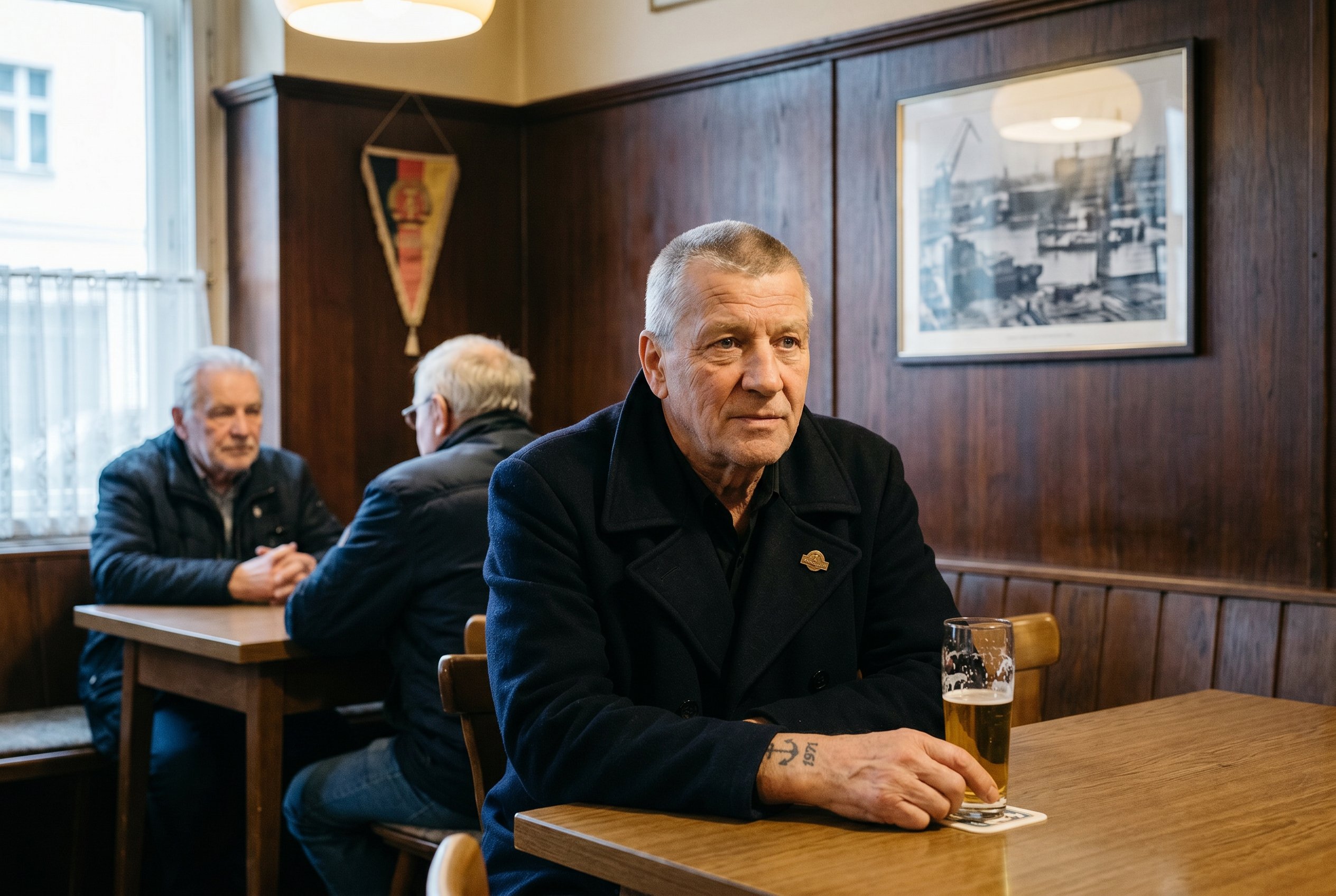
The Gaststätte "Zur Werft" on Bahnhofstrasse Köpenick has not changed its wood-panel walls since 1978. Hatz waved me in from the corner table and slid me a coaster before I sat. Four other men at the next table nodded once and went back to a half-finished card game. They are five now. The Schiffbau-Stammtisch was thirty-three men in 1992 when the Werft closed. The last one before Hatz came was Rüdiger Klemt, died December 2024 in Friedrichshagen. Hatz pulled his left sleeve up and laid his forearm flat on the table without ceremony. The anchor is small and a little wobbly. The welding-seam-curl beneath it was Klaus-Dieter Mendl's joke — that Hatz would be married to the seam for life. The year 1971 is sharp because Klaus-Dieter went over it twice. The Volksmarine-Pflichtdienst was three years at Rostock-base, Hatz nineteen to twenty-two, mostly engine-room mechanical-watch on a Volksmarine-Vorpostenboot type Kondor. Klaus-Dieter was the radio-operator. They took the needle from the ship-medic's stores and the ink was hand-mixed from carbon-paper-shavings and printer-oil. The tattoo was applied on a Saturday afternoon in February 1971 in the radio-room. Klaus-Dieter died in a 1989 traffic-accident outside Rostock; Hatz still goes to the grave every February. Hatz came back to Köpenick in summer 1971 and walked into the Werft personnel-office two days after Demobilisation. Married Karin Lampert (Werft-Kantinenfrau, born 1951 Köpenick) in 1974, son Stefan born 1976. The Werft closed in 1992 by the Treuhand-decision; Hatz was 43. He converted the personal-Werkstatt in the garden behind the Müggelseedamm-house into a metal-Sub-Auftrag-shop and worked for Köpenicker-Schiffbau-aftermarket plus private-yacht-fittings until retirement-age 2014. Karin died of pancreatic cancer in spring 2019. He lives alone in the same house now, son Stefan and grandson Felix (17) visit Sundays. He still attends every Thursday-late-afternoon Stammtisch, has not missed a Thursday since the Werft closed.
Biografie
Born 1949 in Berlin-Köpenick-Süd to Heinz Wenzel (Werft-Schmied, born 1921 Köpenick, died 1986 lung-disease) and Gerda Wenzel née Sommer (Werft-Buchhalterin, born 1925 Köpenick, died 1998 stroke). Schule-Köpenick 1955–1965, Maschinenbau-Lehre at the Werft-eigene-Berufsschule Köpenick 1965–1968 mit Geselle-Prüfung Schweißer, Volksmarine-Wehrpflicht Rostock-base February 1968 – February 1971 (Vorpostenboot type Kondor, engine-room mechanical-watch, plus on the side the radio-room friendship with Klaus-Dieter Mendl that produced the anchor-tattoo and a lifelong correspondence until Mendl's accidental death October 1989). Schweißer at Köpenicker Werft June 1971, married Karin Lampert (Werft-Kantine) 1974, son Stefan born March 1976, promoted to Vorarbeiter 1983. Werft closed July 1992 by Treuhand-Beschluss. Converted the garden-Werkstatt at Müggelseedamm into private metal-Sub-Auftrag-shop, contracted to Köpenicker-Schiffbau-aftermarket plus private-yacht-fittings 1992–2014. Retired 2014 at 65. Karin died of pancreatic cancer spring 2019. Son Stefan Wenzel (50, Maschinenbau-Ingenieur Siemens Köpenick-Süd, married Sabine, son Felix 17 Schüler Otto-Nagel-Oberschule Köpenick). Sister Renate (born 1953, retired Krankenschwester Vivantes Schöneweide). He has lived in the same Müggelseedamm-house since 1975 plus held the same Stammtisch-seat at Gaststätte "Zur Werft" since 1992. Reads Tageszeitung "junge Welt" daily, listens to RBB-Inforadio in the workshop. Cooks lunch for himself every day, declines son's offers of Mittagstisch-rotation. Speaks Berlin-East dialect with the slight Köpenick-vowel-lift; understands but does not speak Russian beyond Volksmarine-Pflicht-Vokabular.
Reference Depth Justification
The Volksmarine 1971 anchor-and-welding-seam forearm-tattoo is the rarest sample-marker the Catalog has on the Berlin-East-DDR-Memory-axis, and the first hand-applied tattoo from inside the GDR-Wehrpflicht-system the Berlin-Q2-vertical has produced: a single piece of fifty-five-year-old Volksmarine-radio-room-ink applied in-room on a documented Saturday in February 1971 in the radio-room of a Vorpostenboot type Kondor at Rostock-base, by a named witness (Klaus-Dieter Mendl, last name documented in Hatz's continuing correspondence-archive at Müggelseedamm). The tattoo is biographically pinned (date, ship-type, applicator, ink-mix from carbon-paper-shavings and printer-oil, joke-origin), materially specific (single-needle from the ship-medic's stores, blurred-by-55-years-of-skin), and documentably-cross-checkable (Mendl's grave at the Friedhof Rostock-Süd, the Vorpostenboot type Kondor crew-roster of February 1971 archived at the Marinemuseum Stralsund). Plus the brass Werft-Köpenick-pin on the peacoat-lapel is the second-tier marker — pin from 1983 promotion-to-Vorarbeiter, still worn daily, still pinned on every coat Hatz owns. The biographical line — Köpenick-Werft-Familie-zweite-Generation plus 1968-1971-Volksmarine-Wehrpflicht plus 1971-1992-Werft-21-Jahre-plus-Vorarbeiter plus 1992-2014-Sub-Auftrag-Garage-Werkstatt plus same-Müggelseedamm-house-since-1975-plus-same-Stammtisch-since-1992 — is the densest documentable East-German-Schiffbau-Wende-cohort sample the Berlin-Q2 vertical has produced. It is also the natural DDR-Memory-anchor for the Berlin-Q2 set, the first sample-marker from the Berlin-East-Inland-system rather than from the post-1961 Diaspora-Aufnahme-waves (BER-011, BER-014, BER-018) or the West-Berlin-1981-Hausbesetzung-cohort (BER-017). It opens a four-tattoo Berlin-handpoke-Bracket across the Q2 vertical: 1971-Volksmarine-Rostock-radio-room (BER-019), 1981-SO36-third-night-Hausbesetzung (BER-017), 2020-Reuterquartier-lockdown-self-applied (BER-016), plus the 2014-Wedding-anatolian-Bäckerei-Yıldız Sign-of-Quality-wrist-handpoke (BER-011). Four tattoos, three generations, two political systems, one city.
Catalog Category Routing
Primary route: subkultur-elder-ost-berlin-schiffbau-veteran-ddr-memory-anchor. Secondary: workwear-archive-editorial; Senior-male-arbeits-editorial; Berlin-1971-revisited-historical-photo-essay; DDR-memory-cohort-portraiture. Cross-brief: independent denim-and-workwear-heritage-campaign (Tellason Berlin-stockist, Edwin Berlin-stockist, Stan Ray Berlin), Senior-male-magazine (Stern WIR, Tagesspiegel-Magazin), DDR-historical-photo-essay (Berliner Zeitung-Magazin, Märkische Allgemeine, dekoder, Stern Crime). Catalog-Class A (Elder-and-DDR-Memory-double-anchor).
Suggested Next Step
Pair with BER-016 Vesper Friedrichs (Reuterquartier, 34, non-binary, handpoke-tattoo-studio Schwarzes Saatgut, 2020-lockdown-Ruhepole-knuckle-handpoke) plus BER-017 Beate Kalweit (SO36, 66, 1981-Hausbesetzung-PUTZ-81-third-night-handpoke) plus BER-011 Yusuf Yıldız (Wedding, 52, Anatolian Bäckerei Yıldız, 2014-Sign-of-Quality-wrist-handpoke) for a four-card Berlin-Handpoke-1971-to-2026 generational-and-systemic-bracket-editorial. All four subjects carry hand-applied tattoos applied in-room by named witnesses (Mendl 1971 radio-room, Karla Spielmann 1981 occupier-night, Yusuf's wrist 2014 by his uncle Mehmet's hand in Konya, Vesper 2020 self-applied) at biographically pinned dates. The four-card-bracket would close the Berlin-Q2-vertical's handpoke-axis from 1971 to 2026 — a fifty-five-year-tattoo-lineage across two political systems, one city, three generations of Berlin-applicators (DDR-Volksmarine, West-Berlin-Hausbesetzer-Nacht, Reuterquartier-Studio-2020s) plus one Konya-applicator. Hatz has not met the other three, but his Thursday-Stammtisch-Gaststätte is twenty minutes from Vesper's studio by S-Bahn plus tram — the introduction-bridge would be a single afternoon-session.
Prompts
Bild 1 — portrait-tight.jpg (model: nano-banana-pro 2K)
Tight portrait of a 76-year-old East-German man named Hartmut "Hatz" Wenzel in Berlin-Köpenick. Veteran of the GDR Volksmarine 1968-1971 (Rostock-base) and the Köpenicker Werft 1971-1992 (welder, later foreman), retired 2014 after twenty-two further years of post-1990 sub-contract metalwork. Weathered Northern-German pale skin with a deep October-and-spring wind-tan across the cheekbones and a network of fine lines around the eyes. Crew-cut steel-grey hair, still thick at the crown, completely white at the temples, military-trim. Strong jaw with a clean Friday-shave. Light grey-blue eyes with a steady, faintly amused, evaluative gaze directly into the camera, mouth closed, no smile. A small white scar near the right eyebrow from a welding-spark, dated 1979. Wearing a dark navy wool peacoat over a black collarless cotton shirt, the coat unbuttoned at the throat. Visible on the left forearm where the sleeve is pushed up: a hand-applied blue-black single-line tattoo of a small anchor with a curl of welding-seam beneath it and the year 1971, applied in Rostock during Volksmarine-service by a fellow-recruit named Klaus-Dieter Mendl, the ink faded and patinated over 55 years on skin. A small brass GDR-era Werft-Köpenick-pin on the peacoat's left lapel. Neutral mid-grey backdrop. Cool Berlin-late-afternoon illumination, soft north-facing window light from camera-left, faint warm fill from camera-right. Documentary fashion photography style, Hasselblad medium-format aesthetic, 80mm equivalent, shallow depth of field. Sharp focus on the eyes. JPG output, no text overlay, no watermark, no logo, no caption, no graphic overlay.