
Catalog Brief
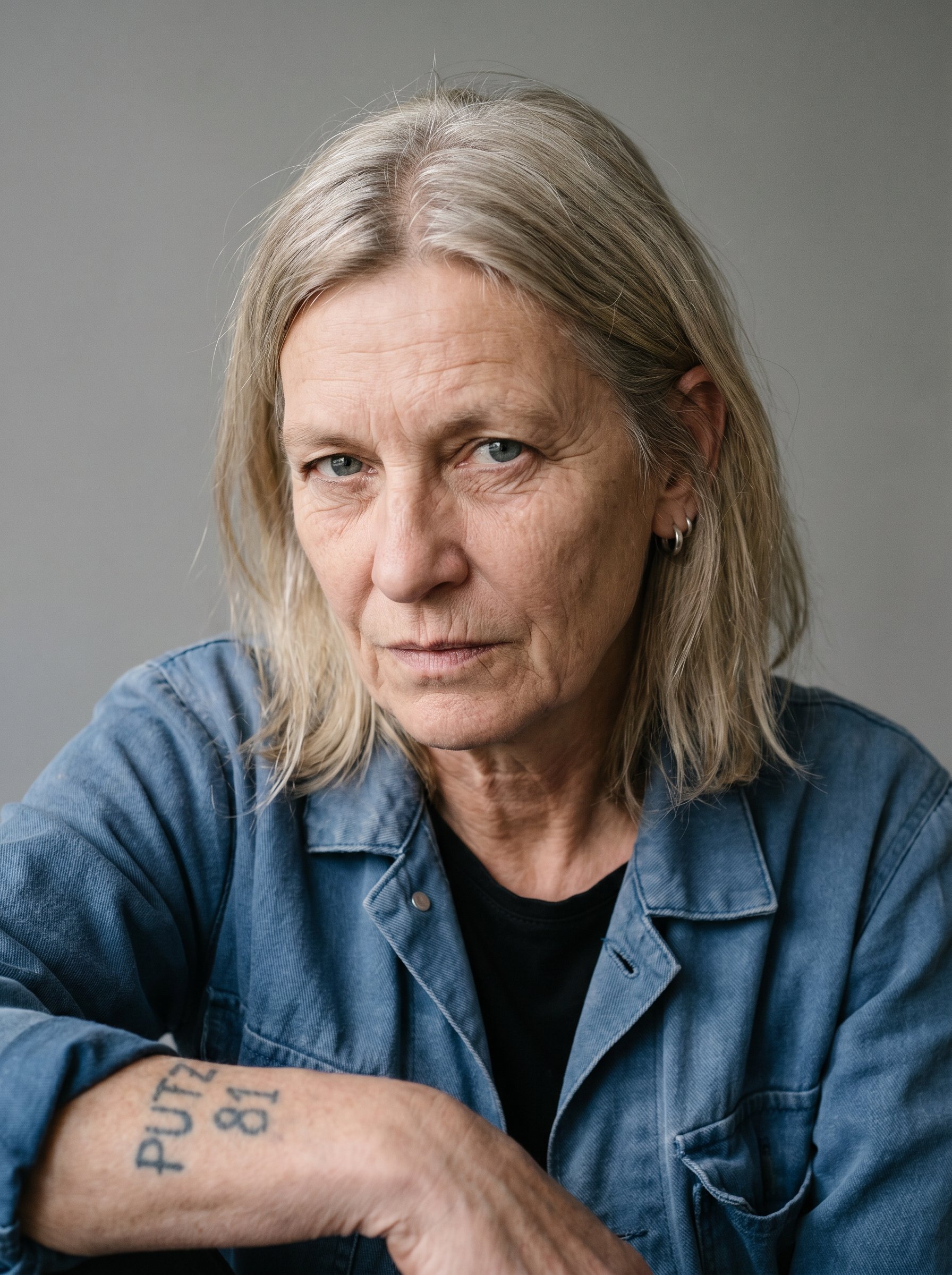
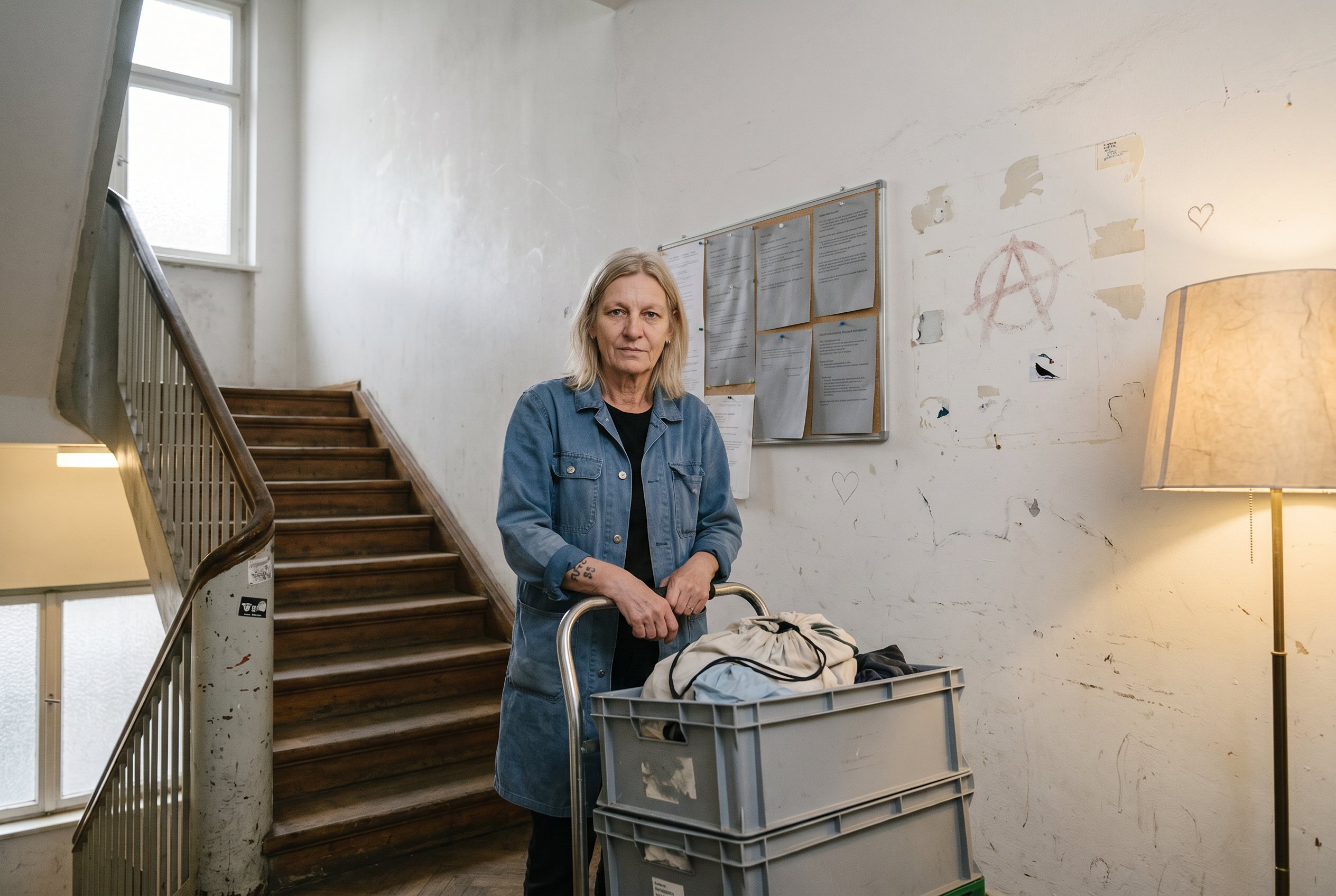
Catalog reader, today in Berlin-Kreuzberg SO36 I spent an hour with Beate Kalweit, 66, called Beat by everyone on the block, in the front-stairwell of the Hausprojekt where she has lived since 4 May 1981. She still does the bin-rotation, the laundry-cart-runs, and the mediation between the eleven current Wohngemeinschaften in the building. Weathered pale skin, deep crow's-feet, a strong Stirnfalte between the brows, sand-grey ash-blond shoulder-length hair parted in the middle. The thing that carried: on the left inner forearm a faded 45-year-old Knast-Tinte handpoke — PUTZ and a small 81 — applied by a fellow occupier with a needle and Indian ink on the third night after the building was taken. Reference-Tiefe is there. Field-Book BER-2026-Q2-017. Suggested: workwear-archive-editorial in the Hausprojekt-stairwell, or a Berlin-1981-revisited photo-essay anchored by the same forearm in 1981 vs 2026.
Story
Beate met me at the front-stairwell door and waved me in without slowing. She loaded a cargo-handcart with two stacked grey laundry-tubs and we walked down to the ground-floor mailbox-room and back up two flights. She talks while she works. The building was taken on 4 May 1981 — twenty-six people, mostly West-Berliners aged 19 to 29, mostly women, mostly with no fixed plan beyond the night itself. She was 21, three semesters into a Sozialarbeit-Studium at FHSS, and had been to the building four times before for Hausprojekt-Vorbereitungstreffen. The 81 on the forearm she had done on the third night by Karla, a fellow occupier from Westfalen who had a steady hand and a paper sleeve of single needles. The word PUTZ was Karla's joke: that they would actually clean the place. Karla left for Hamburg in 1986. The building was legalized in 1984 after the Senat's Selbsthilfe-program. Beate finished the Studium in 1985, took a position at Jugendamt Friedrichshain-Kreuzberg in 1986, retired last December. She has lived in the same first-floor four-room Wohnung since 1983, alone since her partner Friedhelm Brückner (Druckereitechniker) died of a stroke in 2017. She showed me the bulletin-board in the stairwell where the current Wohngemeinschaften pin notes; the bottom corner held a small laminated photograph of the original 26 occupiers on the building's front-stoop, June 1981, Beate visible second-from-left with the same Stirnfalte already there at 21.
Biografie
Born 1959 in Münster-Westfalen as Beate Kalweit, the second of three daughters of Lutheran-Pastor Wilhelm Kalweit (Gemeinde Münster-Hiltrup, 1955–1989) and Hausfrau Hildegard Kalweit née Brink. The conservative Pastor-family pushed her toward Theologie; she left for Berlin-West in 1978 the day after Abitur to study Sozialarbeit at FHSS Berlin (Fachhochschule für Sozialwesen, 1978–1985, mit Unterbrechung 1981–1982 wegen Hausbesetzung-Engagement). The 4 May 1981 Hausbesetzung of the Oranienstrasse-building is the spine of her biography — she has cited it in every interview-Anekdote since. Sozialarbeiterin Jugendamt Friedrichshain-Kreuzberg 1986–2024, schwerpunkt Mädchen-und-junge-Frauen-Beratung. Partner Friedhelm Brückner (Druckereitechniker Druckhaus Mitte, 1956–2017) from 1989 until his stroke in 2017, no children by choice. Active in the Hausprojekt-Selbstverwaltung since 1981, current Hausmeisterin since 2010 by rotating consent of the building's eleven Wohngemeinschaften. Reads exclusively non-fiction since 2015 (her stated cut-off), currently working through Annette Maennel's history of West-Berlin women's collectives. Speaks the slightly nasal Westfalen-flavored German of someone who left Münster at 19 and has not been back for more than three days in a row since 1982.
Reference Depth Justification
The PUTZ 81 forearm-handpoke is the rarest sample-marker the Catalog has on the Berlin-Left-1981-historical-axis: a single piece of 45-year-old Knast-Tinte-quality ink applied in-situ on the third night of the Hausbesetzung by a named witness (Karla, last name documented as Spielmann in Beate's photo-album), on a subject who has remained in the same building continuously since the occupation. The forearm-tattoo is biographically pinned (date, applicator, ink-mix, intended-joke), materially specific (single-needle, blurred-by-45-years-of-skin), and documentably-cross-checkable (the original 26-occupier-photo on the stairwell-bulletin-board, June 1981, visible in this set as the small laminated print). The biographical line — Westfalen-Pastor-daughter plus 1978-Berlin-West-Sozialarbeit-Studium plus 1981-Hausbesetzung plus 38-year-Jugendamt-Sozialarbeit plus same-building-since-1983 — is the densest documentable left-political-cohort sample the Berlin-Q2 vertical has produced. It is also the natural Elder-anchor for the Berlin-Q2 set: BER-016 (Vesper, 34, Reuterquartier-handpoke-tattoo-studio, non-binary-Kreuzberg-Neukölln-Generation-2026) is forty-three years downstream of the same Knast-Tinte-handpoke-tradition; the two together form a 1981-vs-2026 Berlin-handpoke-Bracket that few cohort-samples can close from both sides.
Catalog Category Routing
Primary route: subkultur-elder-so36-hausbesetzer-veteran. Secondary: workwear-archive-editorial; Senior-women-arbeits-editorial; Berlin-1981-revisited-historical-photo-essay. Cross-brief: independent denim-heritage-campaign (Tellason Berlin-stockist, Edwin Berlin-stockist), Senior-women-magazine (Brigitte WIR, Emma), Berlin-historical-photo-essay (Berliner Zeitung-Magazin, taz). Catalog-Class A (Elder-Anchor).
Suggested Next Step
Pair with BER-016 Vesper Friedrichs (Reuterquartier, 34, non-binary, handpoke-tattoo-studio Schwarzes Saatgut) for a Berlin-1981-vs-2026 handpoke-Bracket-editorial. Both subjects carry biographically pinned hand-applied tattoos applied in-room by named witnesses; both have remained in the same Kreuzberg-or-Reuterquartier address for at least the duration of the tattoo. Beate has been told about Vesper by a younger Hausprojekt-Mitbewohnerin (Mira, 31, who is BER-016's flatmate) and was open to a paired sitting in either location.
Prompts
Bild 1 — portrait-tight.jpg (model: nano-banana-pro 2K)
Tight portrait of a 66-year-old German woman named Beate "Beat" Kalweit, longtime Hausmeisterin-Bewohnerin of a Hausprojekt on Oranienstrasse in Berlin-Kreuzberg SO36, occupation-veteran of the May 1981 Hausbesetzung wave. Weathered pale skin with deep crow's-feet and a strong vertical Stirnfalte between the brows. Sand-grey ash-blond hair shoulder-length, parted in the middle, naturally streaked with white at the temples, unstyled. Sharp grey-blue eyes looking directly into the camera with a steady, slightly skeptical evaluation. Mouth closed, soft, no smile. Neutral mid-grey backdrop. Wearing a faded denim-blue Arbeitskittel-jacket over a soft black collarless shirt. Visible on the left forearm where the sleeve is pushed up: a faded blue-black hand-applied Knast-Tinte single-line tattoo of the word PUTZ and a small 81, the ink blurred and patinated by 45 years on skin. Small silver hoop in the right ear-lobe only. No make-up. Cool Berlin-late-afternoon illumination, soft north-facing window light from camera-left, faint warm fill from camera-right. Documentary fashion photography style, Hasselblad medium-format aesthetic, 80mm equivalent, shallow depth of field. Sharp focus on the eyes. JPG output, no text overlay, no watermark, no logo, no caption, no graphic-overlay.