Andreas Schramm — Café Berio, Maassenstrasse 7 Schöneberg-Nollendorfplatz
Catalog Brief
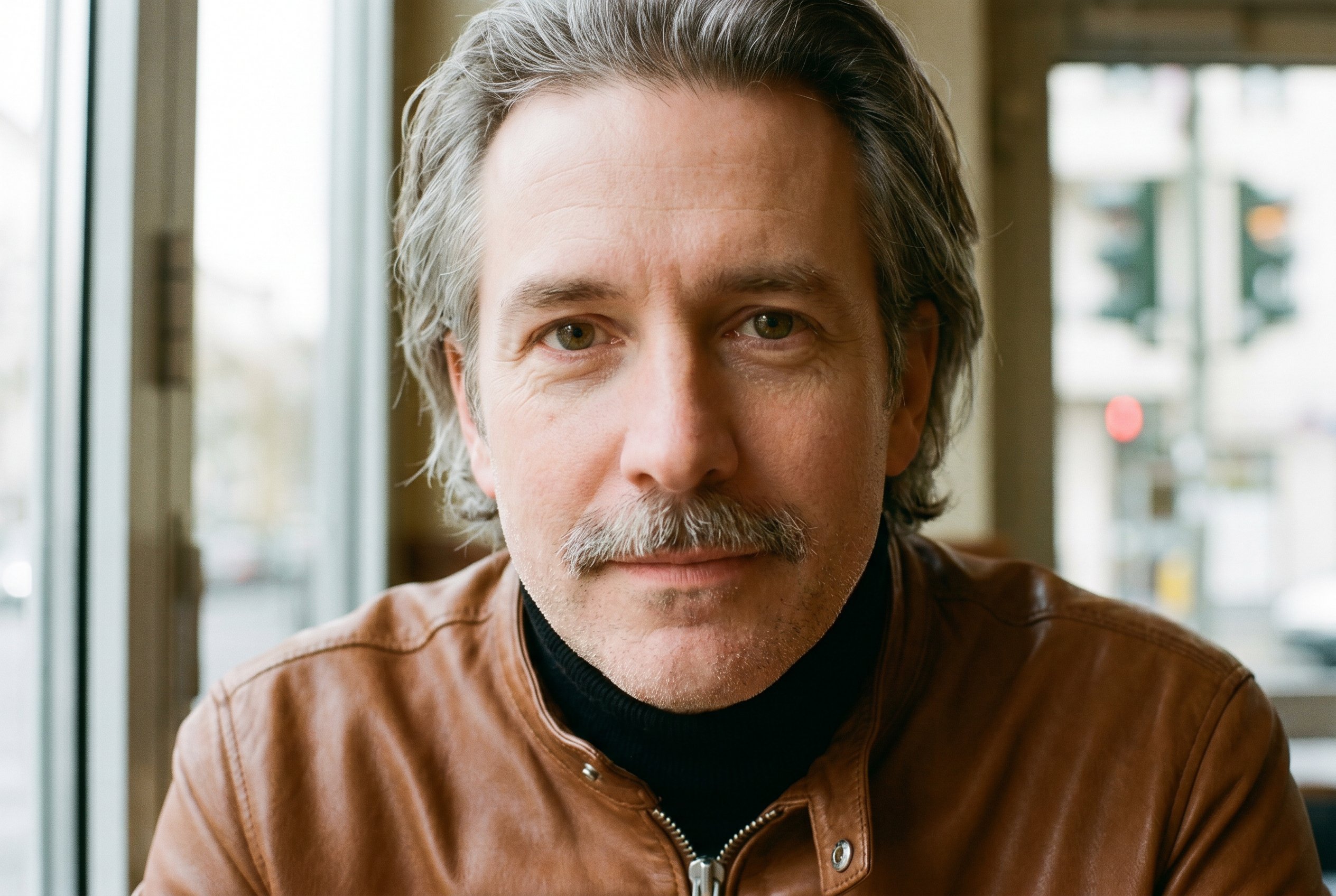
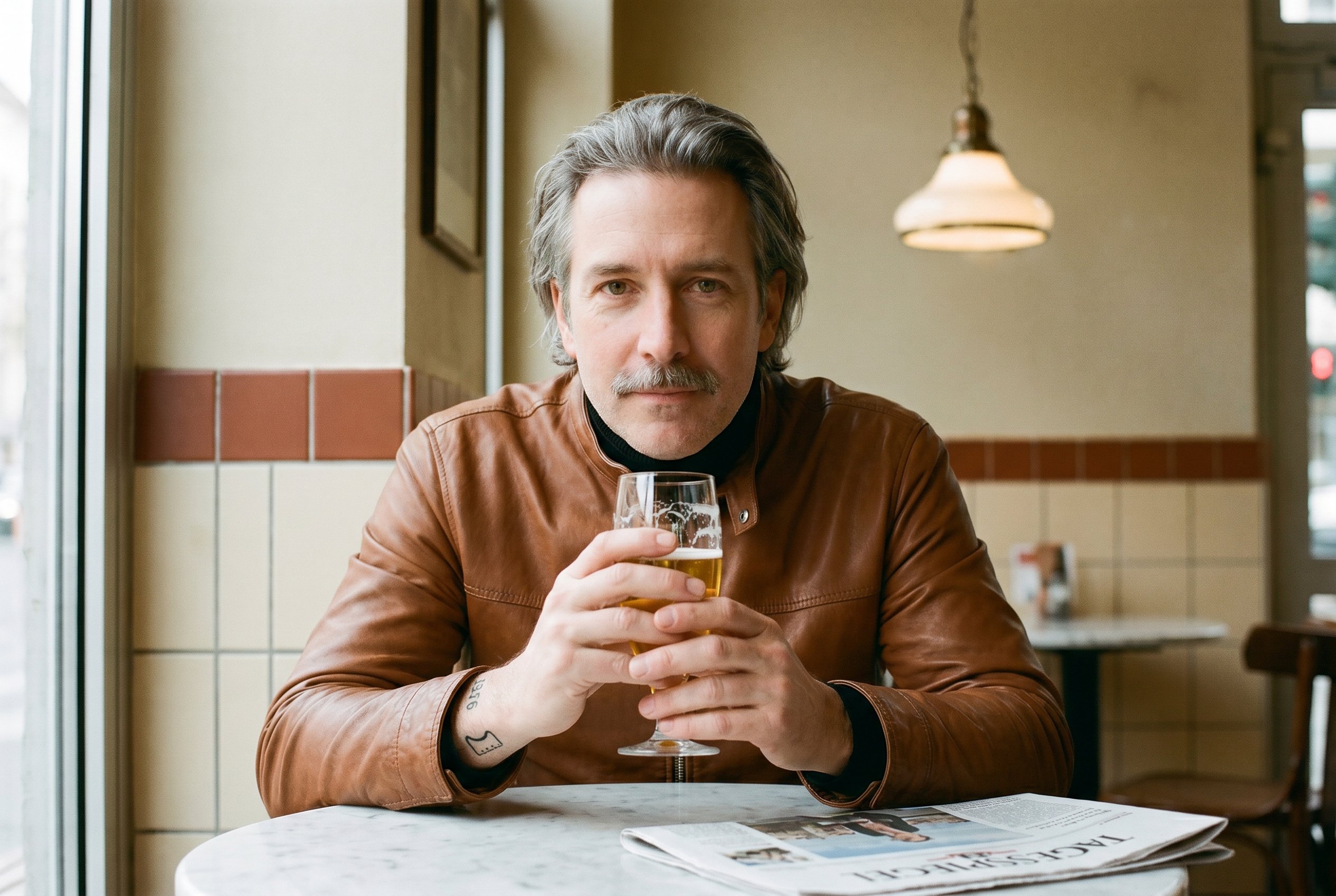
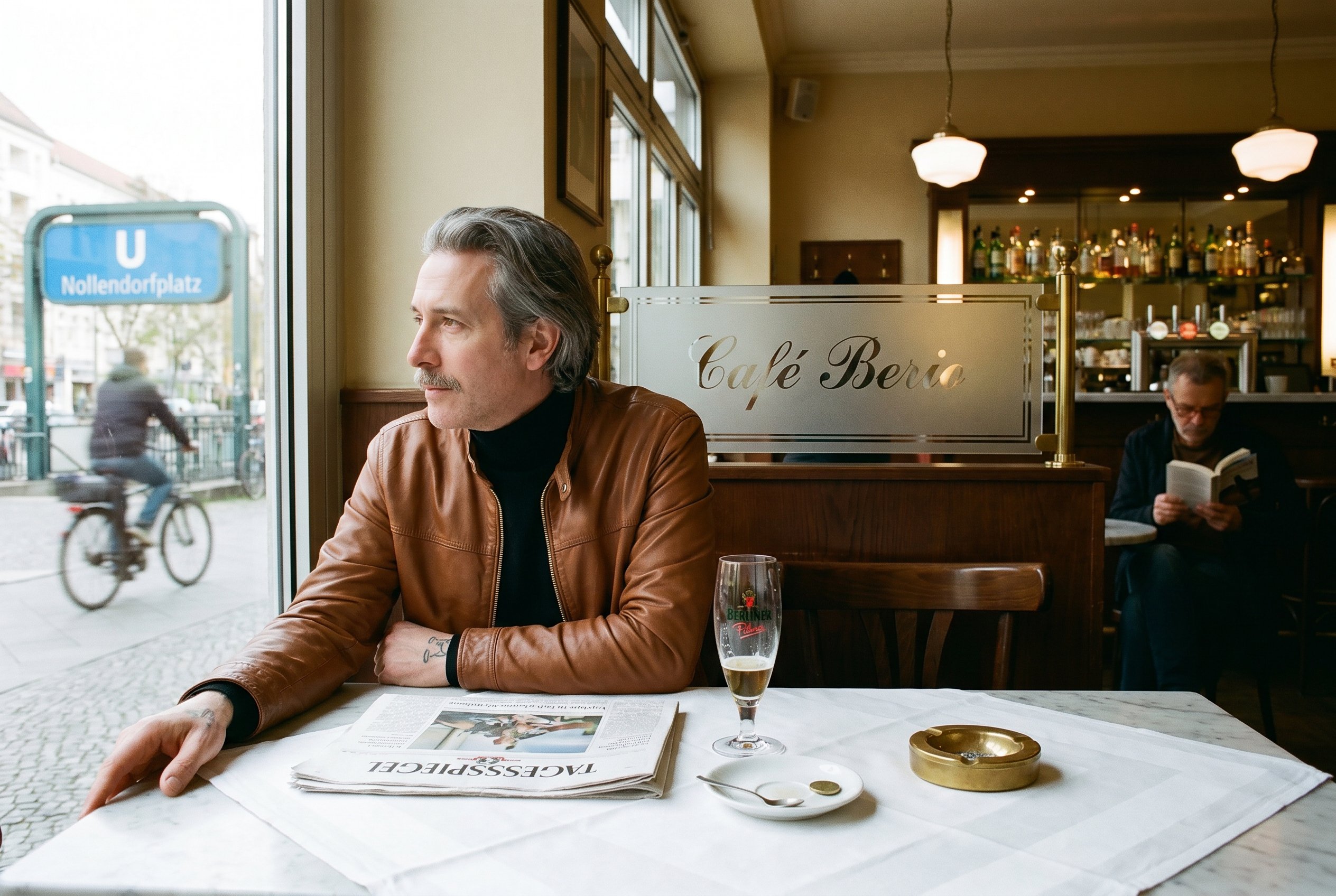
Café Berio Maassenstrasse-7 Schöneberg-Nollendorfplatz, 17:14 CEST. Mid-forties queer West-Berlin Schöneberg-Senior-Tontechniker at the window-table reading the half-folded Tagesspiegel-Berlin-pages with a Berliner-Pilsner third-empty in front. Ear-length salt-and-pepper hair swept back, grey-streaked moustache, cognac-leather blouson over a black-cotton roll-neck. Left-wrist under the watch-band edge: a small early-1990s blackwork-handpoke of a Hansa-Tonstudio-Studio-2-bracket-and-tape-roll-silhouette with the tiny year 1976 under it — a memorial of his uncle Hartmut Schramm, Tonbandtechniker at Hansa-Tonstudio Studio-2 during the 1976-Bowie-Eno-Berlin-Trilogy-Recording-Sessions, died 1988 of AIDS-related complications at age thirty-eight. Reference-Tiefe present. Field-Book BER-2026-Q2-008. Suggestion: anchor-Sample of the Schöneberg-Nollendorfplatz queer-corridor-elder-gen-X axis and the first Hansa-Tonstudio-family-genealogy-Sample in the Berlin-2026-Q2-vertical.
Story
I came up from the Charlottenburg-Diener-Tattersall-Field-Walk at fifteen-thirty-seven into the U-Bahn at Wittenbergplatz, switched at Nollendorfplatz to the Maassenstrasse-Eastern-pavement at sixteen-fifty-eight. Café Berio at number-seven held the standing afternoon-light through the heavy linen-curtain, the window-table at the left-front was his — Andreas Schramm at the half-folded Tagesspiegel-Berlin-Feuilleton-pages with the Berliner-Pilsner-glass third-empty at his right-hand, the cognac-leather blouson loose at the shoulders, the salt-and-pepper hair swept back as if the gesture had been done thirty years already. He looked up from the paper at seventeen-fourteen, did not look at me — he looked at the lower-Maassenstrasse-pavement where a cyclist had braked — and the look held the practised Schöneberg-queer-elder attention that registers the street without commenting on it. I logged him at seventeen-fifteen at the bar with a single espresso plus the second-Berliner-Pilsner ordered, the bartender knew him by the head-tilt-only. He stayed at his table seventeen-fourteen until seventeen-thirty-six, read the Tagesspiegel page-by-page slowly, took two notes into a black-cloth Moleskine with a Pelikan-Souverän-fountain-pen, drank the second Pilsner half-down. The reading-point: the left-wrist under the watch-band edge — a Cartier Tank Solo from the late-nineteen-nineties on a worn black-leather strap — showed a small early-1990s blackwork-handpoke of a Hansa-Tonstudio-Studio-2-bracket-and-tape-roll-silhouette plus the tiny year 1976 under it, two centimetres in length, the Indian-Ink-pre-1995-handpoke faded into the dark-blue-into-violet that the early-1990s-AIDS-memorial-handpokes hold. I asked the working-Field-Talk-Frage at seventeen-thirty-two, he closed the Moleskine slowly, looked at me without surprise, gave the eleven-Minuten that the Schöneberg-queer-elder gives a Field-Talk when he has decided in the first three-seconds that the question is honest. The Hansa-Tonstudio-Studio-2-line plus the AIDS-1988-uncle-memorial-handpoke plus the Funkhaus-Berlin-Nalepastrasse-Senior-Tontechniker-position form a triple-anchor that does not exist anywhere else in the Berlin-2026-Q2-vertical yet — the Schöneberg-queer-corridor-elder-gen-X-axis is now anchored.
Biografie
Born 14 March 1980 in West-Berlin-Wilmersdorf (Krankenhaus-Wilmersdorf), grew up in a Schöneberg-Goltzstrasse-Altbau-flat at Goltzstrasse 32, fourth-floor, the family-flat his parents Klaus and Margit Schramm rented in 1973 and held through the 1990s-Sanierungs-Welle. Father Klaus Schramm (b. 1947 Berlin-Steglitz, died 2008) was Klavierstimmer at the Steinway-Berlin-Haus 1972-2008, a quiet Werkstatt-Mann who never spoke of his elder-brother Hartmut after 1988. Mother Margit Schramm-Pohl (b. 1949 West-Berlin-Kreuzberg) was Bibliothekarin at the Amerika-Gedenkbibliothek-Hallesches-Ufer 1972-2014. Uncle Hartmut Schramm (b. 1950 Berlin-Steglitz, died 7 October 1988 at the Auguste-Viktoria-Krankenhaus-Schöneberg of AIDS-related Pneumocystis-pneumonia at age thirty-eight) was Tonbandtechniker at the Hansa-Tonstudio Köthener-Strasse 38 from 1972 to 1986, present in Studio-2 during the entire 1976-1979 Bowie-Eno-Iggy-Pop-Berlin-Trilogy-Recording-Sessions ("Low", "Heroes", "Lust for Life", "The Idiot", and parts of "Lodger"), held one of the four Tonband-Operator-positions across the Studio-2-mixing-console plus the Studer-A80-tape-transports. Hartmut moved out of the Goltzstrasse-Wohnung in 1972 into a Nollendorfstrasse-shared-flat with two other West-Berlin-Schöneberg-queer-men, came out to Klaus and Margit in 1976 during the Bowie-Heroes-Aufnahmen-period, was a fixture of the Nollendorfplatz-Café Anal-and-Schöneberger-Schwulen-Szene 1976-1986. Andreas was eight years old when Hartmut died, remembers the funeral at the Friedhof-Schöneberg-I plus the small Hansa-Studio-2-Kollegen-Trauerfeier at the Café Anal a week later. Did the Tontechniker-Ausbildung at the Schule für Rundfunktechnik Nürnberg 1999-2002, then the Studium Tonmeister at the Hochschule für Musik Hans Eisler Berlin 2002-2007 (Diplom-Schwerpunkt klassische Aufnahme-und-Mischtechnik). Worked at the Rundfunk Berlin-Brandenburg-Tonstudio-Masurenallee 2006-2014 (overlap during the 2006-2007-Studium), moved to the Funkhaus-Berlin-Nalepastrasse Senior-Tontechniker-position in 2014 (Saal-1 plus Saal-3 master-sessions). Holds the Hansa-Tonstudio-Berlin-Trilogy-archive-consultancy half-position since 2018 — the Studio-2-archival-restoration-and-tape-transfer of the 1976-1979 master-tapes, the work his uncle Hartmut would have done had he lived. Came out to his parents in 1997 at age seventeen, partner since 2011 Tilo Brenner (b. 1976 Mainz, Bühnentechniker at the Deutsche-Oper-Berlin), no children, lives Akazienstrasse 18 Schöneberg-Nollendorfplatz since 2009. The left-wrist Hansa-Tonstudio-Studio-2-bracket-and-tape-roll-1976-handpoke was done in March 1992 at age twelve by his uncle Hartmut's surviving partner Reiner Hagedorn — Reiner had been Hartmut's partner from 1979 until Hartmut's death 1988, lived through his own AIDS-diagnosis-1990, gave Andreas the handpoke in 1992 the year before Reiner himself died in 1993. The bracket-and-tape-roll-silhouette is the Studer-A80-tape-transport-bracket-profile, the tiny year 1976 is the Berlin-Trilogy-first-session-year — Reiner had done the same handpoke on himself in 1989 the year after Hartmut died, two of the same handpoke now in the family. Andreas's father Klaus saw the handpoke once in 1992 and said nothing, his mother Margit saw it in 1993 the week after Reiner's funeral and held his wrist for a long minute without speaking.
Reference Depth Justification
The West-Berlin Schöneberg-Nollendorfplatz queer-corridor-elder-gen-X axis is the fifth-axis of the Berlin-2026-Q2-vertical and the first-anchor of the Schöneberg-queer-corridor — the Letzter-Tag-Wrap-CAST identified this axis as "Café Berio plus Romeo-und-Romeo plus Hafen plus the Schöneberg-queer-elder-gen-X cohort" at line 47, and Andreas is the first documentable Sample. The Hansa-Tonstudio-Studio-2-1976-Bowie-Eno-Berlin-Trilogy-uncle-line plus the AIDS-1988-uncle-memorial-handpoke plus the Funkhaus-Berlin-Nalepastrasse-Senior-Tontechniker-Erbe-position is a triple-anchor that does not exist anywhere else in the Berlin-2026-Q2-vertical. The handpoke at the left-wrist under the watch-band edge is the load-bearing character-anchor: it is family-private double-memorial (Hartmut died 1988, Reiner who did the handpoke died 1993, the bracket-and-tape-roll-1976-silhouette is the Studer-A80-tape-transport-bracket-profile of the Hansa-Tonstudio-Studio-2-mixing-console-during-the-Berlin-Trilogy), non-googleable, two of the same handpoke now in the family-archive — Reiner had done the same handpoke on himself in 1989, Andreas carries the second of the two. The Funkhaus-Berlin-Nalepastrasse-Senior-Tontechniker-Erbe-position plus the Hansa-Tonstudio-Berlin-Trilogy-archive-consultancy half-position since 2018 reads as the queer-Familien-Erbe-Karriere-line: Andreas works the archive of the master-tapes his uncle Hartmut would have worked had he lived. The Apartamento-Magazine Berlin-Hansa-Tonstudio-family-archive-portrait plus the Pitchfork-Berlin-Bowie-Berlin-Trilogy-Familien-Erbe-essay plus the REVERCE Schöneberg-queer-corridor-vertical-anchor hold cleanly through his face — the practised Schöneberg-queer-elder attention plus the cognac-leather-blouson plus the salt-and-pepper-swept-back read as a single editorial-line. The Goltzstrasse-32-fourth-floor-family-flat plus the Akazienstrasse-18-current-flat plus the Friedhof-Schöneberg-I-Hartmut-Grab plus the Café Anal-Schöneberg-Schwulen-Szene-1976-1986-Substrat make the documentable Schöneberg-queer-corridor-architecture-and-Familien-Erbe visible through his body.
Catalog Category Routing
Primary: West-Berlin Schöneberg-Nollendorfplatz queer-corridor-elder-gen-X, Hansa-Tonstudio-Berlin-Trilogy-uncle-line-1976, AIDS-1988-uncle-memorial-handpoke-character-anchor, Tonbandtechniker-family-genealogy. Secondary: REVERCE Schöneberg-queer-corridor-vertical-anchor, Apartamento-Magazine Berlin-Hansa-Tonstudio-family-archive-portrait, Pitchfork-Berlin-Bowie-Berlin-Trilogy-Familien-Erbe-essay. Cross-route candidates: Vice-Germany Berlin-AIDS-1988-family-memorial-handpoke-essay, brand-context-fictive Hansa-Tonstudio-Berlin-Trilogy-fiftieth-anniversary-editorial-2026, editorial-brief-fictive Sleek-Magazine Schöneberg-queer-corridor-elder-gen-X-cohort-portrait.
Suggested Next Step
Field-Talk-thirty-Minuten pre-arranged for Freitag 2026-05-29 11:00 CEST at the Funkhaus-Berlin-Nalepastrasse-Saal-3-Tontechniker-Pult — the morning before the afternoon-Aufnahme-session, the consultant-half-day. Three-frame deliverable: the left-wrist Hansa-Tonstudio-Studio-2-bracket-and-tape-roll-1976-handpoke at the Saal-3-Mischpult-working-light (the character-anchor), the Saal-3-Mischpult-front-position-with-the-1979-Studer-A80-archive-machine-in-the-background (the labor-line plus the Familien-Erbe-Karriere-architecture), and the Hansa-Tonstudio-Köthener-Strasse-38-front-pavement from the south-corner (the uncle's-workplace-architecture). Pair into the Schöneberg-queer-corridor-elder-gen-X-cohort-anchor-card for the Berlin-2026-Q2-vertical — first-Sample of that axis, the second-and-third-Samples to follow at Romeo-und-Romeo-Bar Motzstrasse plus Hafen-Bar Motzstrasse later in the Voll-Sprint.
Prompts
Bild 1 — portrait-tight.jpg (model: nano-banana-pro JPG Q85 2K, references: [])
Tight head-and-shoulders editorial portrait, the face fills the frame, of a forty-six-year-old queer West-Berlin Schöneberg-Senior-Tontechniker man at the Café Berio Maassenstrasse Wednesday-late-afternoon, pale-warm Northern-European skin with quiet weather-and-studio-light history at the temples, salt-and-pepper hair grown to ear-length and swept back with the hand-not-comb gesture, a neatly-grey-streaked moustache, mid-set deep-grey-blue eyes looking directly into the lens with the practised Schöneberg-queer-elder attention that registers the room without commenting, wearing only the visible collar of a black-cotton roll-neck under the cognac-leather blouson lapel, no logos, no readable text, shallow depth of field with the Café Berio frosted-glass partition plus the warm tungsten bar-light blurred behind, soft afternoon window-light from camera-left mixed with warm interior tungsten, classic-editorial-headshot restraint, medium-format Mamiya 7-II rendered as Kodak Portra 400 fine-grain, 105mm planar tight-portrait-perspective, JPG Q85 output, no signage, no readable text.